There are moments in technology when a new capability arrives and quietly improves an existing process, and then there are moments when the technology changes what businesses believe is possible in the first place. Generative AI models belong to the second category. What began with impressive demonstrations of machines generating human-like text, images, code, audio, and video has rapidly moved into enterprise environments where organizations are using these models to develop software, analyze information, automate workflows, support customers, accelerate research, and create new products. The important shift is that generative AI is no longer being treated purely as a consumer technology. It is becoming an industrial capability.
The adoption numbers make the scale of this transition difficult to ignore. McKinsey's 2025 global AI survey found that 79% of respondents reported regular generative AI use in at least one business function, while overall AI use reached 88%. Yet the same research showed that only a small minority of organizations had fully scaled AI across the enterprise. This tells us something important: the generative AI boom is real, but the transformation is still in its early chapters. Businesses have discovered what these models can do; the next challenge is learning how to turn that capability into repeatable, measurable business value.
That distinction separates the current AI excitement from a sustainable industrial transformation. Asking an AI model to write an email is useful. Connecting a generative model to an organization's knowledge base, ERP, CRM, software environment, customer-support system, and operational workflows is potentially transformative. The first improves an individual task. The second can change how an organization works.
What Exactly Are Generative AI Models?
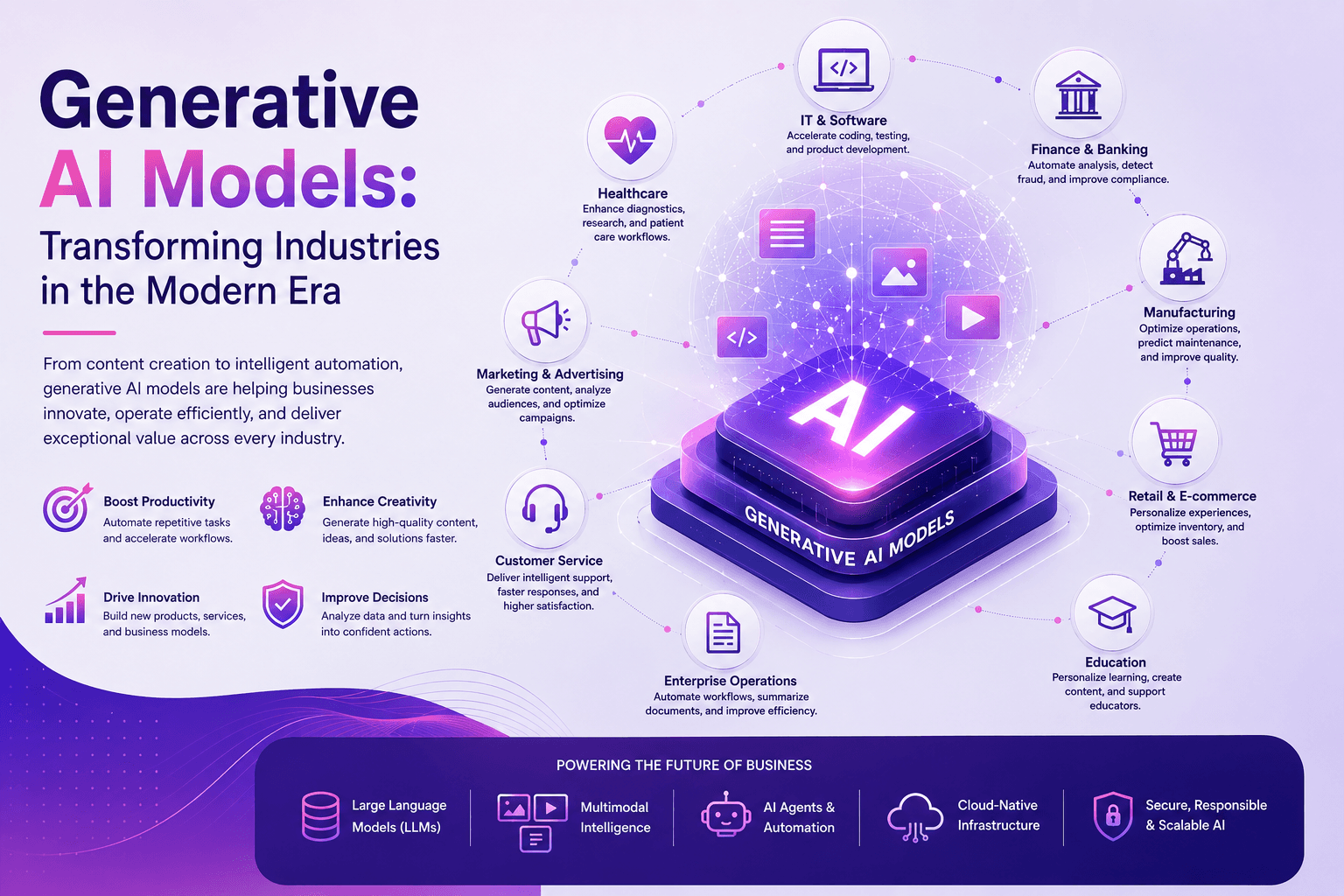
Generative AI models are artificial intelligence systems designed to create new content based on patterns learned from large datasets. Depending on the model and its architecture, that content can include text, software code, images, audio, video, structured information, or combinations of these formats.
Large language models, commonly called LLMs, are one of the most visible categories. They process and generate language, making them useful for conversation, summarization, reasoning, coding, research assistance, document analysis, and knowledge retrieval. Multimodal models extend this concept by working across different forms of information, allowing systems to understand combinations of text, images, audio, video, and other inputs.
This is what makes modern generative AI different from many earlier forms of business automation. Traditional automation generally follows explicit instructions. If a certain condition occurs, the system performs a predefined action. Generative AI introduces a layer of flexible interpretation. A user can provide a loosely structured request, and the model can interpret the intent, retrieve relevant information, generate an output, and in increasingly advanced systems, interact with other software tools.
That flexibility is opening the door to a new generation of enterprise applications.
The Generative AI Boom Is Becoming an Industrial Movement
The initial generative AI wave was heavily associated with chatbots and content creation. Businesses experimented with AI writing assistants, image generators, meeting summarizers, and coding tools. Those applications demonstrated the technology's accessibility, but the bigger industrial opportunity is emerging as companies connect generative AI to specific business processes.
McKinsey's research shows that technology companies lead generative AI adoption across functions, while product and service development is among the most common enterprise applications. Across the industries surveyed, an average of 71% of organizations reported using generative AI in at least one business function in 2025.
The reason is straightforward. Generative AI is particularly powerful when an organization deals with large amounts of information, repetitive knowledge work, complex documentation, customer interactions, or software development.
Think about what happens inside a modern enterprise every day: thousands of emails, reports, tickets, invoices, contracts, customer conversations, product documents, technical logs, meetings, policies, and datasets are created. Much of this information is useful, but humans have limited time to read and process it.
Generative AI can act as a new interface between people and that information.
Instead of searching through dozens of documents, employees can ask a question.
Instead of manually summarizing a meeting, they can generate a structured summary.
Instead of starting software documentation from a blank page, developers can generate a first draft.
Instead of reading hundreds of customer comments individually, organizations can identify recurring themes.
That is where generative AI begins to look less like a chatbot and more like enterprise infrastructure.
Why Generative AI Is Different From Traditional AI
Traditional AI has already been used for years in areas such as fraud detection, recommendation systems, predictive maintenance, demand forecasting, and image recognition. Generative AI adds another dimension: it can produce new outputs rather than simply classify or predict existing ones.
For example, a traditional machine-learning system might determine whether a transaction appears fraudulent. A generative AI system could help an analyst summarize the transaction history, explain relevant patterns, prepare an investigation report, and answer follow-up questions using approved information.
The distinction matters because it changes how humans interact with technology.
Traditional AI often operates behind the scenes.
Generative AI can operate directly at the interface between people and software.
That makes the technology particularly powerful in knowledge-intensive industries. Employees do not necessarily need to understand the underlying database structure or technical system. They can communicate with the system using natural language.
This creates a new possibility for enterprise software: software that can understand what users are trying to accomplish rather than simply waiting for them to navigate predefined menus.
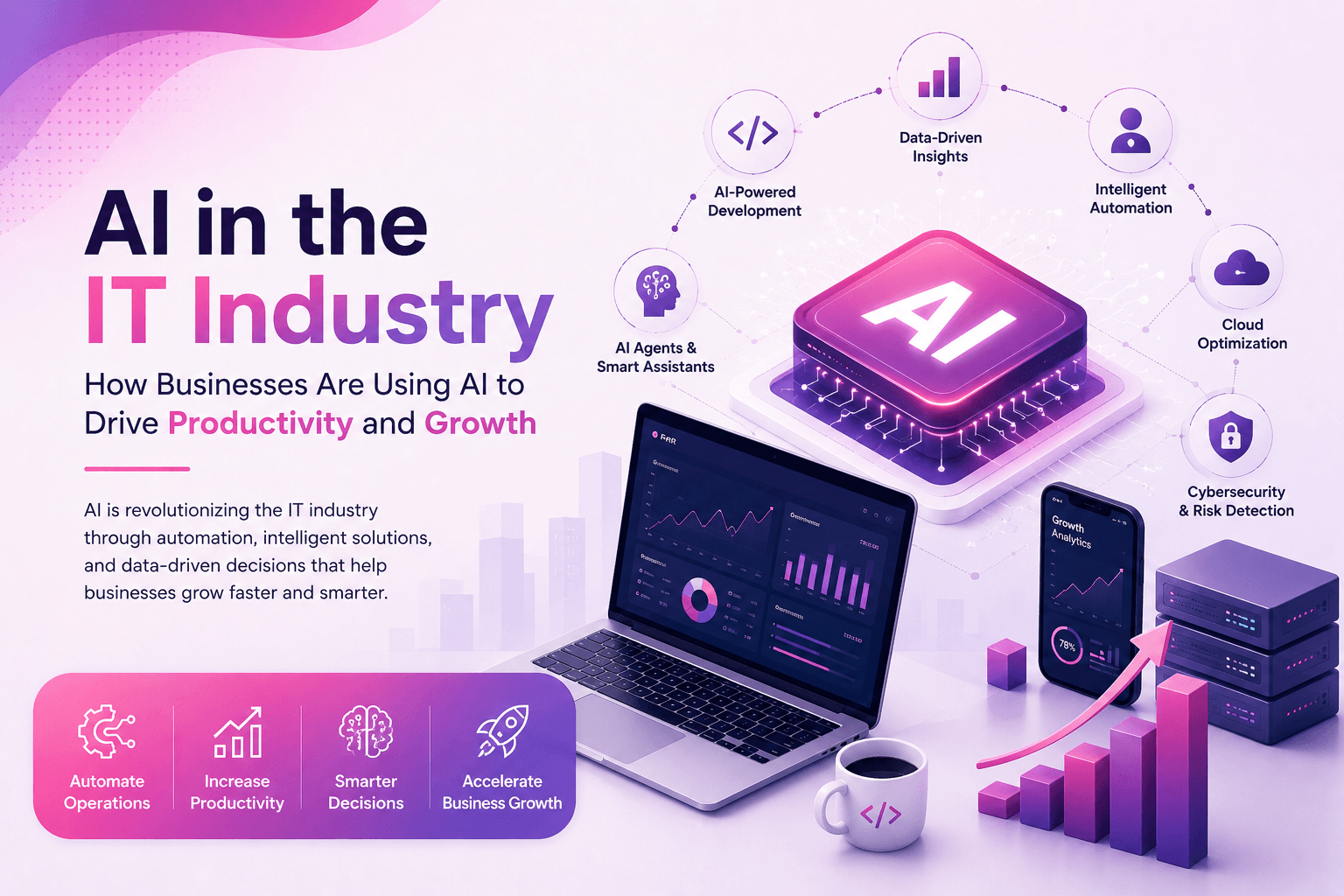
Generative AI in the IT and Software Industry
The IT industry has arguably experienced one of the most immediate impacts of generative AI. Software development contains many tasks that involve language, patterns, documentation, and structured problem-solving—all areas where modern AI models are increasingly capable.
Developers can use generative AI to generate code, explain unfamiliar functions, create test cases, identify potential bugs, write documentation, convert code between languages, and assist with debugging. Product teams can use it to transform requirements into user stories and prototypes. QA teams can generate testing scenarios. Support teams can summarize technical issues and search knowledge bases.
The bigger change is not simply that developers can write code faster.
It is that the cost of experimentation is falling.
A software team can explore an idea, create a prototype, test it, modify it, and iterate more rapidly. This can shorten the distance between an idea and a working product.
Stanford's AI Index has also documented how heavily industry has moved into the development of advanced AI models. In 2024, nearly 90% of notable AI models originated from industry, compared with 60% in 2023.
This reflects an important reality: generative AI is no longer developing primarily as an academic experiment. It has become a major industrial technology race.
Generative AI Is Changing Healthcare
Healthcare is one of the most interesting examples because the industry combines massive amounts of information with extremely high requirements for accuracy, privacy, and accountability.
Generative AI can assist with clinical documentation, administrative workflows, patient communication, medical research, knowledge retrieval, and summarization. It can help healthcare professionals interact with complex information more efficiently without requiring them to manually search through every relevant document.
McKinsey's 2025 research found that 85% of surveyed healthcare leaders were exploring or had already adopted generative AI capabilities.
The opportunity extends beyond hospitals. Pharmaceutical companies can use generative AI to accelerate research workflows and analyze scientific information. Medical technology companies can use AI to improve documentation and support services. Healthcare administrators can use it to automate repetitive communication and information-processing tasks.
But healthcare also demonstrates why generative AI cannot be deployed without governance. A model generating fluent language does not automatically mean the information is medically correct. Sensitive health data requires strong security and privacy controls, while consequential decisions require qualified human oversight.
The future of generative AI in healthcare is therefore likely to be AI-assisted rather than blindly AI-controlled.
Generative AI in Manufacturing and Industry 4.0
Manufacturing might appear less suited to generative AI than software or marketing, but the technology is increasingly finding applications across industrial operations.
Manufacturers deal with technical manuals, engineering documentation, maintenance records, supply-chain information, production data, quality reports, and large volumes of operational knowledge. Generative AI can provide employees with natural-language access to that information.
Imagine a maintenance technician asking:
“What are the most likely causes of this equipment warning based on previous maintenance records?”
Instead of manually searching several documents, an AI system connected to approved enterprise information could retrieve relevant knowledge and provide a structured response.
McKinsey's research into advanced manufacturing sites found that AI-based use cases have become increasingly prominent in Industry 4.0 environments. Among 21 newer manufacturing “Lighthouses,” nearly 60% of leading use cases relied on AI, compared with less than 20% among earlier cohorts. Those implementations reported results including significant productivity gains, service-level improvements, defect reduction, and energy savings.
Generative AI adds another layer by making complex industrial information easier for employees to access and use.
Generative AI in Finance and Banking
Financial institutions operate on information. Transactions, regulations, financial reports, customer records, risk assessments, contracts, market information, and compliance documentation create enormous volumes of structured and unstructured data.
Generative AI can help financial teams summarize reports, analyze documents, support customer service, assist employees with internal knowledge, prepare drafts, and make large collections of information easier to navigate.
Consider regulatory compliance. Financial institutions must continuously interpret changing requirements and ensure that internal processes align with them. Generative AI can assist professionals by organizing regulatory information, comparing documents, summarizing changes, and helping teams identify relevant areas for review.
Customer service is another major use case. Instead of forcing customers to navigate complex knowledge bases, AI assistants can provide conversational support while escalating sensitive or complicated cases to human specialists.
However, financial institutions must be particularly careful about hallucinations, privacy, security, explainability, and regulatory compliance. Generative AI can produce convincing language even when an answer is incorrect. In finance, confidence without accuracy is dangerous.
The winning approach will therefore be AI-assisted finance with strong controls, not unrestricted automation.
Generative AI Is Transforming Retail and E-Commerce
Retail businesses have an enormous amount of customer-facing content: product descriptions, advertisements, emails, customer questions, reviews, catalogs, social media posts, and support conversations.
Generative AI can accelerate the creation and personalization of that content. But its potential goes beyond marketing.
Retailers can use AI to summarize customer feedback, analyze product reviews, create personalized recommendations, support customer service, generate product information, and assist employees with inventory or operational knowledge.
Imagine a retailer receiving thousands of product reviews every month. Reading each one manually is unrealistic. A generative AI system can analyze them at scale and identify common complaints, recurring positive themes, product-quality issues, or emerging customer preferences.
This turns unstructured customer feedback into usable business intelligence.
The broader shift is important: generative AI can turn language into data and data back into useful language.
That two-way interaction makes it especially valuable in customer-centric industries.
Generative AI in Marketing and Advertising
Marketing was one of the earliest areas to embrace generative AI because the technology naturally fits content-intensive workflows.
Businesses can use AI to create first drafts of advertisements, social media content, email campaigns, product descriptions, market research summaries, and creative concepts. But the more mature use of generative AI is moving beyond simply producing more content.
AI can help marketers understand customers, personalize communication, test messaging variations, analyze campaign performance, and connect different sources of market intelligence.
This creates an interesting shift from content generation to intelligent content operations.
The goal is not to publish 1,000 AI-generated articles because AI makes writing faster. The goal is to create better communication, understand audiences more effectively, and make marketing teams more productive.
That distinction matters because the internet is already filling with low-quality AI-generated material. Businesses that use AI simply to produce more noise may gain little. Businesses that use it to improve research, personalization, creativity, and decision-making can create much more meaningful value.
Generative AI in Education
Education is another industry where generative AI is changing established workflows.
Students can use AI for explanations, brainstorming, practice questions, tutoring, and personalized learning. Teachers can use it to generate lesson materials, summarize educational resources, develop assessment ideas, and adapt content for different learning levels.
Educational institutions can also use AI for administrative functions such as communication, student support, knowledge retrieval, and documentation.
The most interesting possibility is personalized learning.
Traditional education often delivers the same material to a large group of students. Generative AI can potentially provide individualized explanations based on a student's questions, learning pace, and knowledge gaps.
But again, the technology should support educators rather than replace them. Education involves motivation, emotional intelligence, mentorship, judgment, and human connection—areas where technology alone cannot replicate the complete role of a teacher.
Generative AI can become a powerful educational assistant, but the teacher remains central to the learning environment.
Generative AI Is Becoming an Enterprise Knowledge Layer
One of the most valuable applications of generative AI may be something less flashy than image generation or automated content.
Enterprise knowledge.
Every organization has knowledge scattered across documents, emails, databases, policies, presentations, technical manuals, project files, and internal systems.
The problem is that employees often know information exists but do not know where to find it.
Generative AI can become an intelligent interface over this knowledge.
An employee could ask:
“What is our process for onboarding a new enterprise client?”
Instead of searching through multiple systems, the AI could retrieve information from approved sources and provide a structured answer.
This is especially valuable for large organizations where institutional knowledge is distributed across departments.
It can also help reduce the impact of employee turnover. When experienced employees leave, they take years of accumulated knowledge with them. An enterprise AI system connected to properly governed organizational knowledge can help preserve and distribute some of that institutional information.
This is one reason why generative AI may become deeply embedded into future ERP, CRM, HR, knowledge-management, and collaboration platforms.
The Rise of Multimodal Generative AI
Text was only the beginning.
Modern generative AI increasingly operates across multiple forms of information. Multimodal systems can work with combinations of text, images, audio, video, and other data types.
For businesses, this opens entirely new possibilities.
A manufacturing company could provide an image of equipment damage alongside maintenance records and ask an AI system to help classify the issue.
A retailer could combine product images and descriptions to generate catalog content.
A healthcare organization could use multimodal systems in carefully governed workflows involving medical documentation and visual information.
A software company could provide screenshots and requirements to assist with interface development.
The significance of multimodality is that businesses rarely operate using only one type of information. Real-world work combines documents, conversations, images, numbers, videos, and structured databases.
Generative AI is increasingly capable of bringing those formats together.
The Biggest Problem: The Generative AI Value Paradox
Here is where the AI story becomes more interesting.
If generative AI is so powerful, why are some companies struggling to see major financial results?
McKinsey has described this as a generative AI value paradox. Its 2025 research found that nearly eight in ten organizations reported using generative AI, yet roughly the same proportion reported no significant bottom-line impact. High-value, function-specific use cases were often still stuck in pilot stages.
This is one of the most important findings businesses should understand.
Adopting AI is not the same as transforming a business with AI.
A company can provide every employee with a chatbot and still operate exactly as it did before.
The real value appears when organizations redesign workflows around AI.
Instead of asking:
“Where can we add AI?”
businesses should ask:
“Which business process could fundamentally work better if AI were built into it?”
That question leads to much stronger use cases.
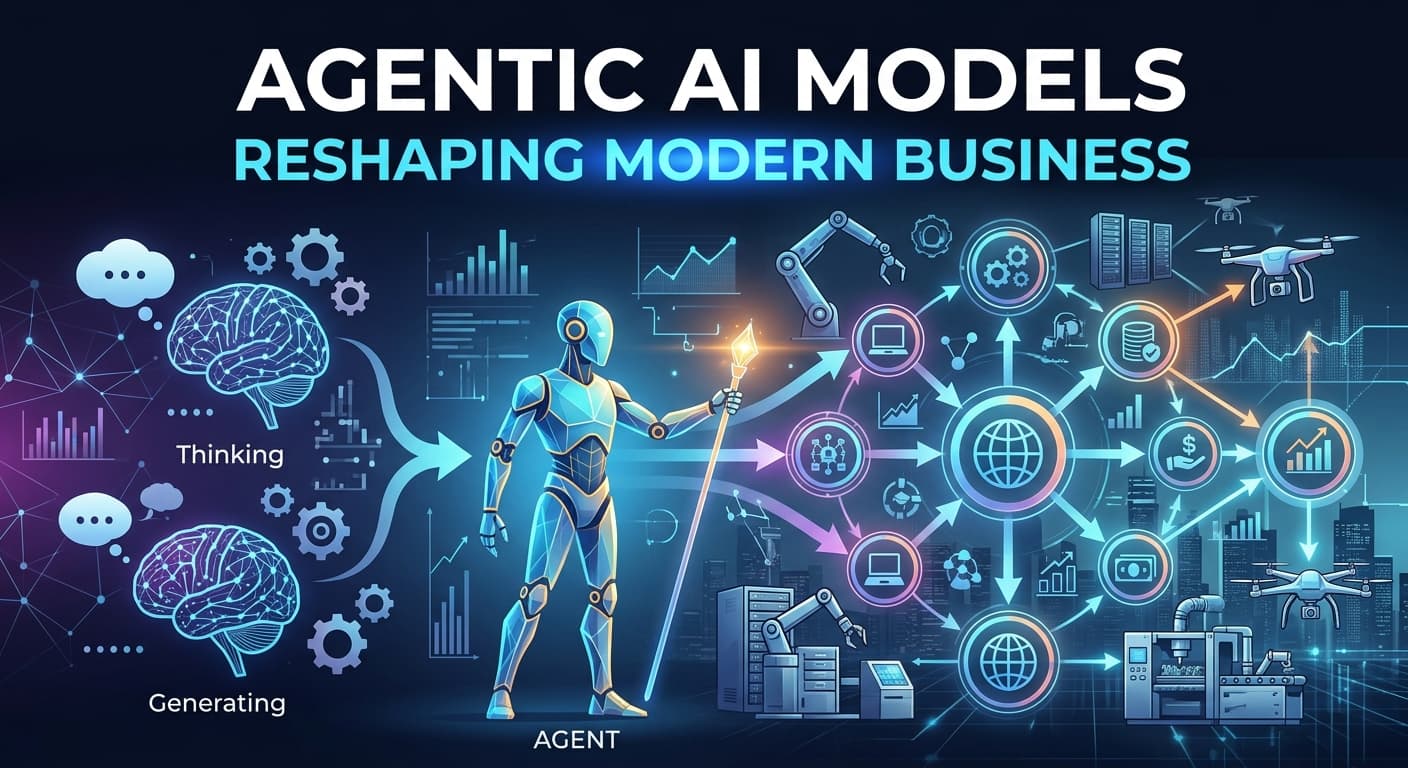
From Copilots to AI Agents
Generative AI initially became popular through copilots—systems that assist humans when asked.
The next evolution is increasingly agentic.
AI agents can potentially interpret objectives, plan multiple steps, interact with software tools, retrieve information, perform actions, and escalate when human approval is needed.
McKinsey's 2025 global AI survey found that 62% of respondents said their organizations were at least experimenting with AI agents.
This could dramatically change enterprise applications.
Imagine an AI agent connected to a company's CRM.
Instead of simply answering:
“Which leads need attention?”
the agent could potentially identify priority leads, research approved customer information, prepare personalized follow-ups, update records, schedule approved communications, and report the results.
That is a much bigger transformation than simply generating text.
The future of generative AI may therefore be less about generating content and more about generating outcomes.
Why Data Will Determine Who Wins
Generative AI models may be powerful, but businesses still need reliable data.
A model cannot magically understand a company's operations if relevant information is fragmented, outdated, inconsistent, or inaccessible.
This is why AI transformation increasingly overlaps with data engineering, cloud architecture, APIs, security, and enterprise integration.
Businesses need to know:
What information does the AI have access to?
Where did that information come from?
Is it accurate?
Who is allowed to access it?
Can the model expose confidential information?
Can the output be audited?
What happens when the model is wrong?
The organizations that build strong data foundations will have an advantage because they can connect generative AI to real business context.
This is also why generic AI tools alone will not necessarily create lasting competitive advantages.
Proprietary data + domain expertise + workflow integration + AI capability can become much harder for competitors to replicate.
Generative AI and the Future of Jobs
The conversation around generative AI often becomes overly focused on job replacement.
The evidence is more complicated.
PwC's 2025 Global AI Jobs Barometer found that AI-exposed industries experienced 27% growth in revenue per employee compared with 9% in less-exposed industries, while workers with AI skills received an average 56% wage premium in 2024. The research analyzed close to one billion job advertisements across six continents.
This does not mean every job is safe or every role will remain unchanged.
It means the economic impact of AI is increasingly being reflected through productivity, skill demand, and job redesign.
Employees who know how to work effectively with generative AI can potentially become significantly more productive.
A developer who understands AI-assisted development can build faster.
A marketer who understands AI research and personalization can operate at greater scale.
A financial analyst who knows how to use AI for document analysis can process more information.
A consultant who can combine domain expertise with AI can potentially serve more clients.
The emerging competition may therefore not be humans versus AI.
It may be AI-enabled professionals versus professionals who do not use AI effectively.
Generative AI Is Becoming a Business Strategy
The biggest change may be happening at the leadership level.
Executives are increasingly moving from asking whether they should experiment with AI to asking where AI should sit within the company's strategy.
McKinsey's 2025 research found that organizations seeing the most value from AI were more likely to pursue growth and innovation alongside efficiency.
That is an important distinction.
AI should not only be viewed as a cost-cutting mechanism.
It can help companies create new products.
It can accelerate innovation.
It can improve customer experience.
It can unlock new services.
It can make smaller teams capable of handling larger workloads.
It can help organizations analyze markets faster.
In other words, generative AI can become a growth engine, not merely an automation engine.
The Industries That Will Benefit Most May Not Be the Ones Moving Fastest
Technology companies have naturally been among the fastest adopters. But some of the largest long-term opportunities may exist in industries where information is complex, workflows are inefficient, and knowledge work represents a significant share of operating costs.
Healthcare, financial services, manufacturing, professional services, education, logistics, energy, retail, and government all have enormous volumes of information that can potentially be transformed through generative AI.
McKinsey's research into oilfield services and equipment provides a useful warning. More than three-quarters of surveyed leaders believed generative AI could deliver operational efficiencies, yet fewer than 25% of companies had progressed beyond pilot phases in 2025. McKinsey estimated that the industry could potentially capture up to $20 billion per year in additional value by scaling AI across current operations.
This illustrates the central challenge of the modern AI era.
The opportunity is enormous.
The implementation is difficult.
What Businesses Need to Do Next
Businesses should not approach generative AI as a race to collect the largest number of AI tools.
A better strategy is to identify high-value workflows.
Start with processes where:
The volume is high.
The work is repetitive.
The information is accessible.
The outcome can be measured.
Human oversight can be maintained.
For example, an organization might begin with customer-support summarization, internal knowledge search, document processing, software development assistance, or marketing research.
Once a successful use case is established, the organization can expand into more sophisticated applications.
The next stage may involve integrating AI into ERP, CRM, HR, finance, supply chain, cybersecurity, and operational systems.
Eventually, AI agents can begin orchestrating approved workflows.
That is how businesses can move from AI experimentation to AI transformation.
The Future: From Generative Models to Intelligent Enterprises
Generative AI models are evolving quickly.
Today's model generates text.
Tomorrow's system may reason across company data.
The next generation may operate multimodally.
Then AI agents may begin executing workflows.
Eventually, businesses may operate with a network of specialized AI systems working alongside human teams.
One system could handle customer intelligence.
Another could monitor cybersecurity.
Another could assist software development.
Another could optimize supply chains.
Another could analyze financial risks.
Humans would remain responsible for strategy, accountability, judgment, relationships, and decisions requiring context and ethics.
This is the emerging idea of the intelligent enterprise.
The business does not simply have AI tools.
AI becomes part of how the organization thinks, operates, learns, and responds.
Conclusion: Generative AI Is Moving From Hype to Industrial Infrastructure
Generative AI models have already changed the way people interact with technology, but their most significant impact may still be ahead.
The technology is moving from individual productivity tools toward enterprise systems, industry-specific applications, multimodal intelligence, and AI agents capable of participating in complex workflows. Current research shows widespread adoption across organizations, rapid investment in AI capabilities, measurable productivity signals, and growing experimentation across industries. At the same time, businesses are discovering that purchasing AI is much easier than integrating it into their core operations.
That is where the next phase of the generative AI boom will be decided.
The winners will not necessarily be the companies using the most AI.
They will be the companies using it most intelligently.
A healthcare organization that connects generative AI to trusted workflows can improve how employees access information. A manufacturer can turn years of technical knowledge into an intelligent operational assistant. A financial institution can make complex information easier to analyze. A software company can accelerate development. A retailer can understand customers at a deeper level. A professional-services company can scale expertise.
The common thread is not the industry.
It is the ability to combine AI models, reliable data, human expertise, and well-designed workflows.
Generative AI started as a technology capable of creating things.
It is increasingly becoming a technology capable of helping businesses create value.
And that is why the generative AI boom is not simply another technology trend. It is becoming one of the defining technological shifts of the modern industrial era.
FAQs
1. What are generative AI models?
Generative AI models are AI systems capable of creating new text, code, images, audio, video, and other content based on learned patterns.
2. How is generative AI transforming industries?
Generative AI is transforming industries by automating knowledge work, accelerating innovation, improving customer experiences, analyzing information, and supporting complex business workflows.
3. Which industries are using generative AI?
Technology, healthcare, finance, manufacturing, retail, education, professional services, energy, and many other industries are actively exploring or adopting generative AI.
4. Can generative AI improve business productivity?
Yes, research increasingly links generative AI use with productivity improvements, although the size of the benefit depends heavily on how deeply AI is integrated into business workflows.
5. What is the future of generative AI?
Generative AI is moving toward multimodal models, enterprise intelligence, AI agents, workflow automation, and increasingly autonomous systems working alongside human teams.
6. What is the biggest challenge with generative AI adoption?
The biggest challenge is moving beyond experimentation and integrating AI into reliable, measurable, secure, and scalable business processes.
7. Will generative AI replace human workers?
Generative AI is more likely to transform many roles by automating repetitive work while increasing the value of human judgment, creativity, expertise, and strategic thinking.
8. Why is data important for generative AI?
Reliable and well-governed data gives generative AI the business context it needs to produce more relevant, trustworthy, and useful outputs.
9. What is the difference between generative AI and AI agents?
Generative AI primarily creates or analyzes information, while AI agents can use AI capabilities, tools, and workflows to pursue goals and perform multiple tasks with varying levels of autonomy.
10. How can a business start using generative AI?
Businesses should begin with specific high-volume, measurable workflows where trusted data, human oversight, and clear business outcomes are available.




 AITech