Artificial intelligence has already changed the way people interact with technology, but the next transformation is going much deeper. Generative AI taught machines to create; agentic AI is teaching them to act. Instead of simply generating an answer when a user enters a prompt, agentic systems can increasingly understand a goal, reason through a problem, plan a sequence of actions, use connected tools, retrieve information, interact with business systems, and complete tasks with varying levels of human oversight. That difference may sound technical, but from a business perspective it is enormous. It means AI is moving from being something employees use into something that can increasingly participate in how work gets done.
The shift is already visible across the enterprise. McKinsey's 2025 global AI survey found that 62% of organizations were experimenting with AI agents, although fewer than 10% reported scaling agents within any individual business function. Technology companies were among the industries reporting the most advanced agent scaling, particularly in software engineering and IT. IBM's 2025 research also found that more than 60% of CEOs said their organizations were actively adopting AI agents, while nearly 70% of executives identified improved decision-making as the leading benefit.
These numbers reveal both sides of the story. Agentic AI is moving quickly, but the world is still learning how to use it properly. Businesses have discovered that giving an AI model the ability to act is very different from giving it the ability to generate text. Once an AI agent can access software, databases, customer information, financial systems, development environments, or operational tools, questions around security, permissions, accountability, governance, and reliability become just as important as intelligence itself.
That is why agentic AI should not be understood simply as “the next chatbot.” It represents a potential change in the operating model of modern organizations.
What Is Agentic AI?
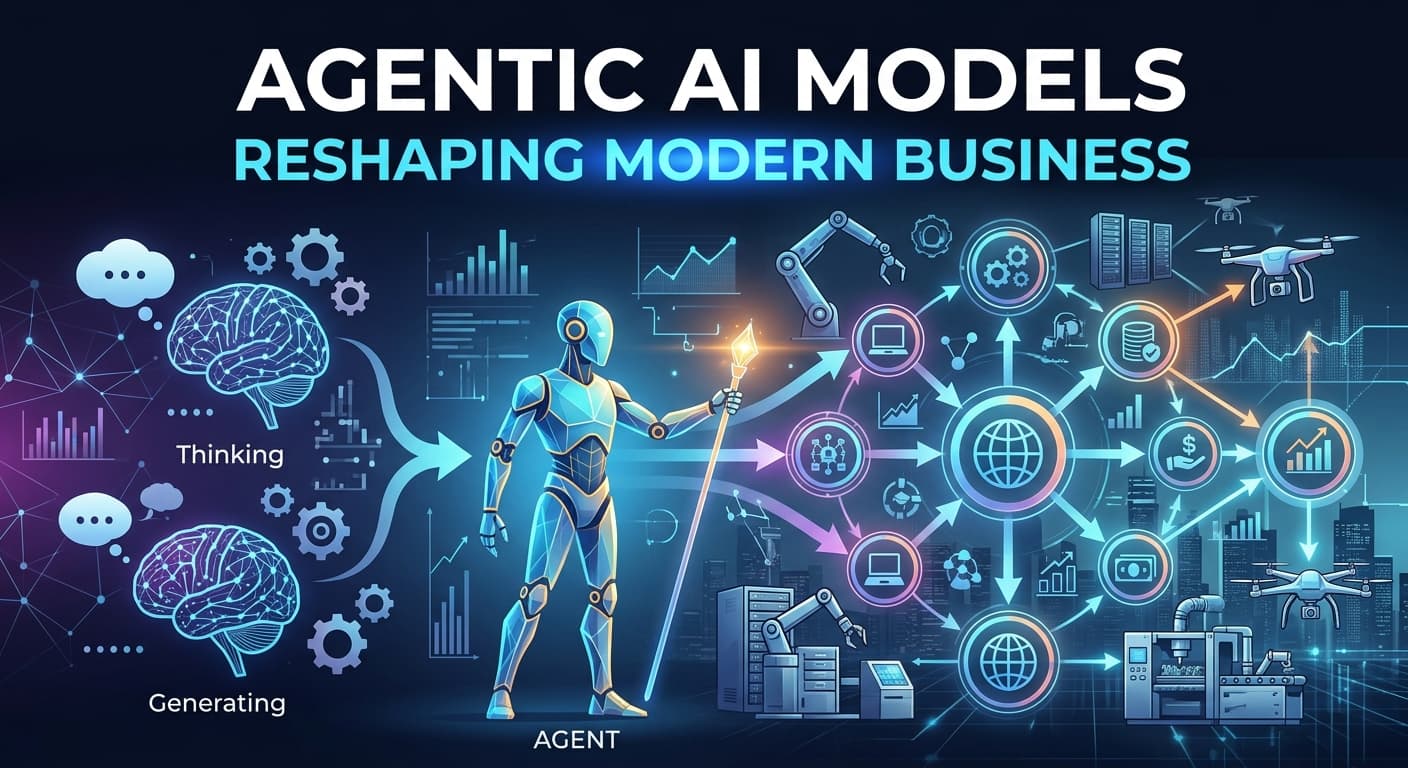
Agentic AI refers to AI systems designed to pursue goals by reasoning, planning, using tools, taking actions, and adapting to changing circumstances rather than merely producing a single response. A conventional chatbot may answer a question. A generative AI assistant may create a report. An AI agent can potentially take that report, identify the next required steps, retrieve relevant information, update a system, communicate with another service, and continue working toward the defined objective.
The distinction can be simplified like this:
Traditional automation: Follow predefined rules.
Generative AI: Generate content or information.
Agentic AI: Understand a goal, determine actions, use tools, and execute a workflow.
This does not mean every AI agent operates completely autonomously. In serious enterprise environments, autonomy is usually controlled through permissions, approval checkpoints, policies, monitoring, and human escalation. An agent might be allowed to analyze customer data but not send an external message without approval. It might prepare a purchase order but require a manager to authorize the transaction. It might identify a security incident and gather evidence while leaving the final response decision to a cybersecurity professional.
That controlled autonomy is where agentic AI becomes particularly interesting for business.
From AI Assistants to AI Workers
The first wave of enterprise AI largely revolved around the concept of the copilot. Employees could ask AI to summarize a meeting, write an email, explain code, analyze a document, or brainstorm ideas.
That model is still valuable, but agentic AI introduces a different relationship.
Instead of saying:
“Help me do this task.”
the employee may eventually say:
“Handle this process according to these rules and let me know when human approval is required.”
The agent then becomes responsible for coordinating multiple steps.
IBM describes an agentic enterprise as an organization where AI agents are integrated across business functions to plan and execute multi-step tasks, respond to changing conditions, and work alongside human employees. Its 2026 research notes that more than 60% of CEOs said their organizations were actively adopting AI agents, while few organizations had integrated agents across every department at scale.
This is an important evolution.
A digital assistant waits for instructions.
An AI agent can potentially monitor, reason, act, and follow through.
That difference could fundamentally change how businesses design workflows.
Why Agentic AI Is Becoming a Big Deal Now
AI agents are not entirely new. Businesses have used automated workflows and software agents for years. What has changed is the combination of increasingly capable foundation models, better reasoning capabilities, tool integration, APIs, cloud infrastructure, structured enterprise data, and natural-language interfaces.
Earlier automation systems were usually predictable because their behavior was tightly programmed. If condition A occurred, action B happened. That was useful for repetitive processes but difficult to apply to situations requiring interpretation.
Modern AI agents can potentially operate in environments where the path is not completely predefined.
A customer may describe a problem differently every time.
A cybersecurity incident may involve several unexpected signals.
A software bug may require examining logs, code, documentation, and recent deployments.
A procurement decision may depend on inventory, supplier performance, pricing, demand, and delivery timelines.
These are not simple “if this, then that” problems.
Agentic systems are designed to work more dynamically with such environments.
This is why businesses are increasingly interested in them—not because they want more AI, but because they want software capable of handling more complex work.
Agentic AI in the IT Industry
The IT industry is one of the clearest environments for agentic AI because technology workflows are already highly digital and interconnected.
Consider software development. A traditional AI coding assistant can generate a function when asked. An agentic development system can potentially understand a feature request, inspect an existing codebase, identify relevant files, generate changes, run tests, analyze failures, revise the implementation, and prepare the result for human review.
That represents a significant change in the software-development lifecycle.
AI agents can potentially assist with:
McKinsey's January 2026 research found that technology organizations reported some of the highest levels of scaled AI-agent use, particularly in software engineering and IT.
The long-term implication is not necessarily that developers disappear. Rather, development teams may spend less time manually coordinating repetitive tasks and more time defining architecture, reviewing AI-generated work, solving complex problems, and making technical decisions.
The developer of the future may increasingly become an orchestrator of intelligent development systems.
Agentic AI and IT Operations
IT operations are another natural environment for AI agents because modern infrastructure generates enormous amounts of information.
Servers produce logs.
Applications produce metrics.
Networks generate alerts.
Cloud platforms generate usage data.
Security systems generate events.
Monitoring platforms continuously report changes.
The challenge is no longer simply collecting information. It is understanding which information matters and what action should follow.
Agentic AI can potentially monitor these environments continuously, investigate anomalies, correlate information from multiple systems, and recommend or perform approved remediation.
IBM reported in March 2026 that an Omdia study of ITOps found that even organizations assigning less than 10% of ITOps duties to AI reported operational improvements, suggesting that businesses are often beginning with smaller integrations before moving toward more advanced deployments.
Imagine an application suddenly becoming slow.
A traditional monitoring system may raise an alert.
An AI agent could potentially investigate recent deployments, inspect infrastructure metrics, examine error logs, compare current traffic with historical behavior, identify a likely cause, and prepare a remediation recommendation.
That turns monitoring into active problem-solving.
Agentic AI in Cybersecurity
Cybersecurity may become one of the most important applications of agentic AI because security teams operate under constant pressure from huge volumes of alerts and increasingly sophisticated threats.
An AI agent can potentially assist with threat detection by correlating signals from endpoint systems, identity platforms, network logs, cloud infrastructure, and security tools.
Instead of treating every alert independently, an agent could investigate relationships between them.
For example, it might notice that an unusual login occurred, followed by suspicious API activity and an unexpected file-access pattern. It could collect relevant evidence, summarize the incident, compare it against known threat patterns, and escalate the case to a human analyst.
The benefit is not simply speed.
It is continuous investigation at machine scale.
However, cybersecurity also demonstrates why agentic AI requires strong governance. Giving an AI agent the ability to modify configurations, disable accounts, isolate systems, or delete files introduces serious operational risks if the system makes a mistake.
The future therefore requires policy-aware autonomy.
Agents should know what they are allowed to do, what they are not allowed to do, and when a human must take control.
Agentic AI in Healthcare
Healthcare presents a fascinating combination of opportunity and responsibility.
Hospitals and healthcare organizations manage enormous amounts of information across clinical documentation, appointments, billing, patient communication, insurance, laboratory systems, staffing, inventory, and administration.
Agentic systems could potentially coordinate many of these workflows.
An administrative agent could identify missing information in a patient's documentation, retrieve approved records, prepare a summary, and route the case to the appropriate team.
A scheduling agent could coordinate appointments based on predefined rules.
A knowledge agent could help staff locate relevant internal policies or information.
A research-focused agent could assist professionals in navigating large collections of scientific literature.
But healthcare is also a high-stakes environment. An agent should not be given unrestricted authority over decisions that could directly affect patient safety.
Human oversight, privacy, security, auditability, and regulatory compliance must remain fundamental.
Agentic AI in healthcare is therefore likely to develop around a human-in-the-loop model, where machines coordinate information and workflows while qualified professionals retain responsibility for consequential decisions.
Agentic AI in Finance and Banking
Finance is another industry where agentic AI can potentially transform operations because financial institutions are built around structured processes, massive datasets, and complex decision workflows.
An AI agent could assist with financial analysis, customer support, compliance reviews, fraud investigations, document processing, reporting, and internal knowledge management.
Imagine a compliance workflow.
A traditional system might flag a transaction for review.
A generative AI assistant might summarize the transaction.
An agentic system could potentially go further: investigate relevant records, compare activity against defined policies, retrieve supporting documents, identify anomalies, prepare an investigation package, and escalate the case when human review is required.
That could significantly reduce the manual effort involved in knowledge-intensive financial processes.
The same concept applies to customer service. Agents could potentially understand customer requests, retrieve account information, resolve approved issues, initiate authorized workflows, and hand complex cases to human specialists.
The biggest challenge is accountability.
Financial systems require strong controls because an incorrect autonomous action can have direct monetary consequences.
The future of agentic finance will therefore likely depend on bounded autonomy rather than unlimited autonomy.
Agentic AI in Manufacturing
Manufacturing is moving toward increasingly intelligent operations, and agentic AI could become an important part of that evolution.
Factories already use sensors, IoT systems, robotics, enterprise software, and industrial analytics. Agentic AI can potentially sit above these systems as a reasoning and orchestration layer.
Imagine a production line experiencing an unexpected decline in output.
An AI agent could examine machine telemetry, maintenance history, production schedules, inventory levels, quality reports, and recent changes. It could identify possible causes and recommend a sequence of actions.
In more advanced environments, agents could potentially coordinate maintenance scheduling, inventory planning, quality investigations, and supplier communication within defined boundaries.
McKinsey's research on advanced industries suggests that agentic AI has the potential to support areas including quality inspection, research and development, sales, customer engagement, and other core industrial processes.
The significant shift is that AI is no longer simply analyzing manufacturing data.
It can potentially coordinate decisions across the manufacturing ecosystem.
Agentic AI in Retail and E-Commerce
Retail is also entering an agentic era.
Today's recommendation engines already predict what customers might want. Agentic commerce takes the idea further by allowing AI systems to potentially search, compare, recommend, negotiate within defined constraints, and complete purchasing workflows.
McKinsey describes agentic commerce as a shift toward AI agents that can anticipate consumer needs, navigate shopping options, and execute transactions according to user intent.
This could fundamentally change e-commerce.
Instead of a customer visiting ten websites to compare products, an AI agent could potentially understand the customer's requirements, evaluate available options, compare price and quality, and present a shortlist.
For businesses, this creates a new challenge.
Historically, companies optimized websites for human visitors and search engines.
They may increasingly need to optimize products and services for AI agents making purchasing decisions on behalf of consumers.
That could create an entirely new dimension of digital commerce.
Agentic AI in Logistics and Supply Chains
Supply chains are complex because they involve multiple variables that change continuously.
Demand changes.
Suppliers experience delays.
Transportation costs fluctuate.
Inventory moves between locations.
Weather can affect logistics.
Customers change orders.
A traditional supply-chain system can report these changes.
An agentic system could potentially respond to them.
Imagine a supplier suddenly reporting a two-week delay.
An AI agent could identify affected orders, examine alternative suppliers, check inventory at other warehouses, estimate customer impact, compare costs, and prepare a revised procurement recommendation.
Instead of employees spending hours coordinating information between departments, the agent can potentially perform the coordination work automatically.
This is one of the strongest use cases for agentic AI because supply-chain management is fundamentally an orchestration problem.
The more systems involved, the more valuable intelligent coordination becomes.
Agentic AI and ERP Systems
The combination of agentic AI + ERP could become one of the most significant developments in enterprise software.
Traditional ERP systems are excellent at recording business activity and enforcing structured workflows.
Generative AI makes those systems easier to interact with.
Agentic AI could make them more proactive.
Consider procurement.
A traditional ERP tells you inventory has fallen below a threshold.
A generative AI assistant explains the situation.
An AI agent could potentially analyze demand, supplier performance, pricing, lead times, purchase history, and financial constraints before preparing a recommended purchase order.
The same concept can apply to finance, HR, inventory, sales, and operations.
This means ERP could evolve from a system of record into a system of intelligent action.
That does not mean the ERP disappears.
It means the ERP becomes part of the environment through which AI agents operate.
Agentic AI Is Changing Customer Service
Customer service has historically been a combination of human agents, scripted workflows, knowledge bases, and increasingly chatbots.
Agentic AI introduces the possibility of an AI system that can actually complete customer-service workflows.
A customer might say:
“My order hasn't arrived, and I need it before Friday.”
A conventional chatbot may provide tracking information.
An agent could potentially check the order, investigate shipping status, evaluate available options, contact approved systems, arrange an authorized solution, update the customer, and escalate if necessary.
That is a fundamentally different experience.
The customer is not simply receiving information.
The customer is receiving action.
IBM's enterprise research identifies improved customer service as one of the potential benefits of agentic enterprises because agents can personalize interactions, access relevant context, and execute tasks across systems.
For businesses, this can potentially reduce response times while allowing human service teams to focus on complex or emotionally sensitive situations.
Multi-Agent Systems: When AI Agents Work Together
The next stage may not involve one AI agent doing everything.
It may involve multiple specialized agents working together.
Imagine an enterprise with:
A finance agent
A sales agent
A procurement agent
A cybersecurity agent
An HR agent
A customer-service agent
An IT operations agent
Each agent has a defined role, permissions, tools, and responsibilities.
A customer order could trigger several coordinated actions.
The sales agent handles the customer relationship.
The inventory agent checks availability.
The procurement agent evaluates replenishment requirements.
The finance agent checks payment conditions.
The logistics agent coordinates delivery.
Humans oversee the system and intervene when decisions exceed defined boundaries.
This is where agentic AI starts looking less like a software feature and more like a digital organizational layer.
The Real Business Value of Agentic AI
The biggest advantage of agentic AI is not that it can generate impressive responses.
It is that it can potentially reduce the number of manual handoffs required to complete work.
Think about a typical business process.
Information moves from one employee to another.
One department requests something from another.
Someone searches for data.
Someone checks a spreadsheet.
Someone sends an email.
Someone waits for approval.
Someone updates a system.
Someone prepares a report.
Someone follows up.
An agentic workflow can potentially connect several of these steps.
That means businesses can begin measuring value through:
Faster cycle times.
Fewer manual handoffs.
Lower operational costs.
Better response times.
Higher employee productivity.
Improved customer experiences.
Faster decision-making.
IBM's 2025 research found that nearly 70% of surveyed executives identified improved decision-making as the leading benefit of agentic AI.
The key word is workflow.
AI agents create the most value when they are connected to complete workflows rather than isolated tasks.
Why Many Agentic AI Projects Are Still Struggling
The agentic AI boom should not be confused with guaranteed success.
McKinsey's research shows a significant gap between experimentation and scaled deployment. Although 62% of organizations reported experimenting with AI agents, fewer than 10% reported scaling them within individual functions.
Why?
Because giving an AI system the ability to act introduces complexity.
The agent needs reliable data.
It needs access to the right tools.
It needs clear permissions.
It needs business context.
It needs monitoring.
It needs evaluation.
It needs fallback mechanisms.
It needs humans who understand how to work with it.
McKinsey's April 2026 research found that eight in ten companies cite data limitations as a roadblock to scaling agentic AI, emphasizing that strong data foundations are essential for meaningful enterprise deployment.
This is why simply buying an AI-agent platform will not transform a business.
The organization itself must be ready.
The Data Foundation Behind Agentic AI
Agentic systems require more than intelligence.
They require context.
An agent cannot make useful decisions if it cannot access the information required to understand the situation.
Consider a procurement agent.
If it knows inventory levels but cannot see supplier performance, it may make poor decisions.
If it sees supplier performance but cannot access financial constraints, its recommendations may be unrealistic.
If it can access everything but lacks proper permissions, it becomes a security risk.
This makes enterprise data architecture extremely important.
Businesses need:
Clean data.
Connected systems.
Clear permissions.
Reliable APIs.
Strong identity management.
Data lineage.
Real-time or appropriately current information.
Well-defined business rules.
Agentic AI therefore sits at the intersection of AI, cloud, data engineering, cybersecurity, APIs, and enterprise software.
Security Becomes More Important When AI Can Act
A chatbot generating an incorrect answer is problematic.
An AI agent executing an incorrect transaction can be much more serious.
This is the fundamental security difference between generative AI and agentic AI.
Once an AI system has access to tools, its potential attack surface expands.
An agent could potentially access confidential information, execute unauthorized actions, misuse credentials, or follow malicious instructions embedded in external data.
McKinsey has highlighted the novel security and governance risks associated with autonomous AI agents, including risks arising from their ability to reason, plan, act, and adapt.
This means agentic architecture must include security from the beginning.
Organizations should consider:
Role-based permissions
Least-privilege access
Human approval for sensitive actions
Detailed audit logs
Agent identity management
Continuous monitoring
Tool-level restrictions
Data-access policies
Incident response mechanisms
The question is not simply:
“Can the agent do this?”
It should also be:
“Should the agent be allowed to do this?”
That distinction will define responsible agentic AI.
Human-in-the-Loop Is Not a Weakness
There is sometimes a perception that an AI system is more advanced if humans are removed from the workflow.
That is not necessarily true.
In high-risk environments, human oversight can actually make an AI system more useful and more trustworthy.
A healthcare agent may prepare information for a physician.
A financial agent may prepare a transaction for approval.
A cybersecurity agent may investigate an incident before a security professional decides how to respond.
A procurement agent may prepare a purchase order before a manager approves it.
The AI handles complexity and speed.
The human handles accountability and judgment.
This creates a powerful model of human + agent collaboration.
IBM's 2026 research emphasizes that agentic enterprises are designed around agents working alongside humans, allowing people to focus more heavily on strategy, innovation, and relationships.
The objective is therefore not maximum autonomy.
It is appropriate autonomy.
Agentic AI and the Future of Employees
Agentic AI will change jobs because it changes the tasks inside jobs.
A project manager may spend less time preparing status reports and more time managing risks.
A developer may spend less time writing repetitive code and more time reviewing architecture.
A customer-service professional may handle fewer routine questions and more complex customer relationships.
A finance analyst may spend less time collecting information and more time interpreting it.
This does not make human expertise irrelevant.
In many cases, it makes expertise more important.
The professional who understands both the business domain and AI systems will be able to supervise agents more effectively.
That creates a new class of worker:
The AI-augmented professional.
These employees understand what AI can do, where it can fail, how to evaluate its output, and how to integrate it into real-world workflows.
That combination of domain expertise and AI literacy could become one of the most valuable professional skill sets of the next decade.
The Rise of the Agentic Enterprise
The long-term vision is not simply companies using several AI agents.
It is companies designed around intelligent workflows.
IBM calls this the movement toward the “agentic enterprise,” where agents become integrated across business functions and help organizations respond dynamically to changing conditions.
Imagine starting a business process without manually coordinating every step.
A customer submits a request.
An agent understands it.
Another agent checks availability.
Another evaluates financial conditions.
Another handles documentation.
Another schedules fulfillment.
A human approves any high-impact action.
The systems update themselves.
The customer receives the result.
The organization learns from the outcome.
This is not science fiction anymore. The pieces required to build such systems already exist.
The challenge is connecting them safely and effectively.
From Generative AI to Agentic AI
The evolution can be understood as a simple progression.
Traditional software follows instructions.
Traditional automation executes predefined workflows.
Generative AI creates information.
AI copilots assist humans.
Agentic AI executes multi-step goals.
Multi-agent systems coordinate specialized AI capabilities.
Agentic enterprises redesign entire business workflows around intelligent systems.
This progression explains why agentic AI is receiving so much attention.
Generative AI changed how humans interact with machines.
Agentic AI could change how businesses operate.
That is a much larger opportunity.
What Businesses Should Do Before Deploying AI Agents
The best approach is not to give an AI agent access to everything and hope for the best.
Businesses should start with clearly defined workflows.
Identify where employees spend excessive time on repetitive coordination.
Find processes with measurable outcomes.
Clean the underlying data.
Define the agent's permissions.
Introduce human approval where required.
Monitor performance.
Measure the results.
Then expand.
A useful starting framework is:
1. Identify the workflow.
Find a process where AI could remove significant friction.
2. Define the goal.
Be specific about what the agent should accomplish.
3. Connect trusted data.
Give the agent access only to information it genuinely needs.
4. Establish permissions.
Define exactly what the agent can read, modify, or execute.
5. Add human checkpoints.
Require approval for sensitive or irreversible actions.
6. Measure outcomes.
Track time, cost, accuracy, customer satisfaction, and business impact.
7. Scale gradually.
Expand only after the agent proves reliable.
This approach is much more sustainable than chasing autonomy for its own sake.
The Future of Agentic AI Models
The next generation of AI agents will likely become more capable, more specialized, and more deeply integrated with enterprise systems.
Agents will increasingly operate across applications rather than inside isolated chat windows.
They will work with structured and unstructured data.
They will use APIs and enterprise tools.
They will collaborate with other agents.
They will remember relevant context within governed boundaries.
They will become better at reasoning through complex workflows.
And businesses will increasingly treat them as part of their digital workforce.
IBM's 2026 research highlights how quickly enterprise agent deployment is expanding while also pointing to a growing governance challenge: only 11% of surveyed technology leaders said they were completely prepared for the scale of AI-agent deployment.
That statistic captures the next challenge perfectly.
The technology is moving quickly.
Organizations need to catch up.
The Agentic Era Is About Outcomes, Not Prompts
The biggest conceptual shift is simple.
The generative AI era taught businesses to think about prompts.
The agentic era will force businesses to think about outcomes.
Instead of asking:
“What prompt should employees use?”
companies will increasingly ask:
“What business outcome should the agent achieve?”
That might be reducing customer-service resolution time.
It might be improving software-release efficiency.
It might be reducing procurement delays.
It might be detecting cybersecurity incidents faster.
It might be improving financial forecasting.
It might be increasing sales conversion.
The technology becomes valuable when the outcome is measurable.
This is why the future of agentic AI will not be determined only by model intelligence.
It will be determined by workflow design, data quality, integration, governance, and business strategy.
Conclusion: Agentic AI Could Redesign How Businesses Work
Generative AI introduced a world where machines could create content, analyze information, write code, summarize knowledge, and communicate naturally.
Agentic AI introduces something more ambitious: machines that can increasingly act on goals.
That shift is already appearing across IT, cybersecurity, healthcare, finance, manufacturing, retail, logistics, customer service, ERP, and enterprise operations. Current research shows that organizations are experimenting rapidly, while only a relatively small percentage have successfully scaled agents across business functions.
That gap represents the biggest opportunity.
Businesses that simply add agents to existing processes may achieve incremental productivity improvements. Businesses that redesign entire workflows around intelligent systems could achieve something much more significant.
The future enterprise may not be organized only around departments and software applications.
It may increasingly be organized around humans, AI agents, data, and intelligent workflows working together.
Humans will provide judgment, creativity, leadership, relationships, and accountability.
Agents will provide speed, scale, continuous monitoring, reasoning, and execution.
And enterprise systems will provide the data and infrastructure connecting everything together.
The goal should never be to make AI as autonomous as possible.
The goal should be to make businesses as intelligent, productive, responsive, and scalable as responsibly possible.
That is the real promise of agentic AI.
The AI revolution started with machines that could answer.
Then came machines that could create.
Now we are entering an era where machines can increasingly act.
And the businesses that learn how to direct that capability effectively may define the next generation of the digital economy.
FAQs
1. What are agentic AI models?
Agentic AI models are intelligent systems that can reason, plan, use tools, execute multi-step tasks, and work toward defined goals with varying levels of autonomy.
2. How is agentic AI different from generative AI?
Generative AI primarily creates or analyzes content, while agentic AI can use AI capabilities to plan and execute actions across connected workflows.
3. How can businesses use AI agents?
Businesses can use AI agents for software development, cybersecurity, customer service, finance, procurement, IT operations, supply chains, and business process automation.
4. Can AI agents replace employees?
AI agents are more likely to automate specific tasks and transform job responsibilities while increasing the importance of human judgment, expertise, creativity, and oversight.
5. What are the benefits of agentic AI?
Key benefits include faster workflows, reduced manual work, improved decision-making, continuous monitoring, greater productivity, and more scalable business operations.
6. What are the risks of AI agents?
Major risks include unauthorized actions, data exposure, incorrect decisions, security vulnerabilities, poor data quality, and inadequate governance.
7. What is a multi-agent AI system?
A multi-agent system uses multiple specialized AI agents that collaborate to complete different parts of a larger business process.
8. Why is data important for agentic AI?
AI agents require reliable business context and connected data to make informed decisions and execute workflows accurately.
9. What is an agentic enterprise?
An agentic enterprise is an organization that integrates AI agents into business workflows so they can assist or execute multi-step processes alongside human employees.
10. What is the future of agentic AI?
The future is moving toward specialized AI agents, multi-agent systems, autonomous workflows, intelligent enterprise software, and deeper human-agent collaboration.




 AITech