Artificial intelligence is no longer sitting quietly inside research laboratories or appearing only in futuristic technology demonstrations. It has moved into boardrooms, customer service departments, finance teams, factories, warehouses, hospitals, educational institutions, and almost every other part of the modern economy. What makes the current AI revolution different is not simply that machines can generate text, recognize images, or answer questions. The bigger change is that AI is increasingly being connected to the systems that actually run businesses. This is where AI-powered ERP solutions are becoming especially important. An ERP system has traditionally been the central nervous system of an organization, connecting finance, inventory, procurement, sales, HR, operations, and reporting. AI is now giving that nervous system something it historically lacked: the ability to interpret information, identify patterns, predict outcomes, and increasingly take action. Microsoft’s 2025 Work Trend Index, based on research involving 31,000 workers across 31 countries, described the emergence of organizations built around human and AI-agent collaboration, while 82% of leaders surveyed said they considered 2025 a pivotal year for rethinking strategy and operations around AI. [Microsoft, 2025 Work Trend Index]
The shift is therefore much bigger than adding a chatbot to an existing ERP dashboard. It represents a movement from software that records what happened toward software that helps determine what should happen next. Consider a conventional inventory system. It may tell a manager that 2,000 units remain in stock. An intelligent ERP can potentially go much further: it can analyze historical sales, seasonal demand, supplier lead times, current orders, pricing changes, and other business signals to identify whether those 2,000 units are sufficient. It can flag a potential shortage before it occurs and recommend an appropriate purchasing action. That difference sounds subtle, but operationally it is enormous. Businesses are moving from simply collecting data to turning data into decisions, and that is one of the defining characteristics of the modern AI era.
The World Is Moving From Digital to Intelligent
The previous phase of digital transformation was largely about replacing paper with software, manual calculations with databases, physical files with cloud storage, and disconnected departments with integrated applications. ERP systems played a major role in that transition because they brought multiple business functions into one structured environment. A finance employee could access financial records, an inventory manager could monitor stock, HR could manage employee information, and leadership could generate reports without depending entirely on spreadsheets scattered across individual computers. That transformation created enormous value, but it also created a new challenge: organizations began accumulating more information than human teams could realistically interpret. AI is emerging as an answer to that problem because it can process large volumes of structured and unstructured information at speeds that would be impossible for a human team working manually.
The distinction between digital and intelligent is important. A digital system might automate a process exactly as it was programmed. An intelligent system can potentially recognize changing circumstances and adjust its recommendations accordingly. A traditional ERP may execute a purchase order after a predefined threshold is reached. An AI-enhanced ERP could evaluate why inventory is moving differently, whether demand is temporary or structural, whether a supplier is becoming unreliable, and whether purchasing more stock is financially sensible. The system does not necessarily replace the manager; instead, it gives the manager a more complete picture before a decision is made. This is why the modern AI conversation should not be reduced to the idea that “AI will replace people.” In many business environments, the more realistic transformation is people working with systems that understand more, respond faster, and surface insights earlier.
AI Is Becoming Part of Everyday Business
AI adoption is increasingly moving beyond experimentation. Stanford’s 2025 AI Index documented rapid growth in corporate AI adoption and highlighted the expanding economic and organizational influence of artificial intelligence. Research published in 2026 examining S&P 500 companies also found that deep AI integration into business processes had grown substantially compared with earlier years, although meaningful enterprise-wide integration remained far from universal. The important lesson is that adoption should not be confused with maturity. A company using an AI writing assistant is not necessarily an AI-native organization, just as having an ERP installed does not automatically make an organization data-driven. The real transformation happens when AI becomes embedded into operational workflows where it can influence measurable outcomes.
This distinction matters for ERP because ERP systems sit at the center of business operations. If AI is connected only to a separate chatbot, its knowledge of the business may remain limited. When AI is integrated with financial transactions, customer records, inventory movements, purchasing information, production data, employee workflows, and other governed business information, its usefulness can become much greater. The system can begin answering questions in business context rather than generic context. Instead of asking a general-purpose AI, “What is cash-flow forecasting?” a finance manager could ask an ERP-integrated intelligence layer, “Which customers are creating the greatest receivables risk this quarter?” The value comes from the combination of AI capability and trusted organizational data.
Why Traditional ERP Systems Are No Longer Enough
Traditional ERP systems are not necessarily obsolete. In fact, their structured databases, transaction controls, workflows, and financial records are precisely what make them valuable foundations for AI. The problem is that many older ERP environments were designed primarily around transaction processing. They are excellent at storing what happened and enforcing business rules, but they may require considerable human effort to understand why something happened and what should happen next. Employees often export data into spreadsheets, build reports manually, compare historical figures, and then discuss possible actions in meetings. The process can work, but it becomes increasingly difficult as organizations grow and the number of variables increases.
Imagine a business with thousands of customers, hundreds of suppliers, multiple warehouses, constantly changing prices, seasonal demand, employee turnover, and fluctuating operating costs. A human management team cannot realistically examine every relationship between those variables every day. An AI-enabled ERP can continuously analyze patterns and highlight exceptions. It can identify unusual spending, detect anomalies in transactions, forecast demand, classify incoming requests, summarize operational information, and provide decision support. The objective is not to make the ERP “fancy.” The objective is to reduce the distance between information and action.
From Recording Data to Understanding Data
This may be the most important change AI introduces to ERP. Traditional ERP software largely answers questions such as: What was sold? What was purchased? What is in inventory? Which invoices are unpaid? How many employees are active? What was revenue last month? Those questions remain important, but modern businesses increasingly need answers such as: Why did sales decline? Which customers are likely to leave? Which products could become overstocked? Which suppliers create the greatest operational risk? Where could cash flow become constrained next month?
AI introduces an analytical layer that can help move from descriptive information toward predictive and prescriptive intelligence. Descriptive analytics tells a business what happened. Predictive analytics estimates what could happen. Prescriptive intelligence goes one step further by recommending potential actions. The quality of those recommendations depends heavily on the quality of the underlying data, the design of the AI system, the organization's governance framework, and human oversight. AI does not magically transform poor information into perfect decisions. In fact, one of the biggest lessons emerging from enterprise AI adoption is that data architecture, integration, governance, and context are just as important as the AI model itself.
What Is an AI-Powered ERP Solution?
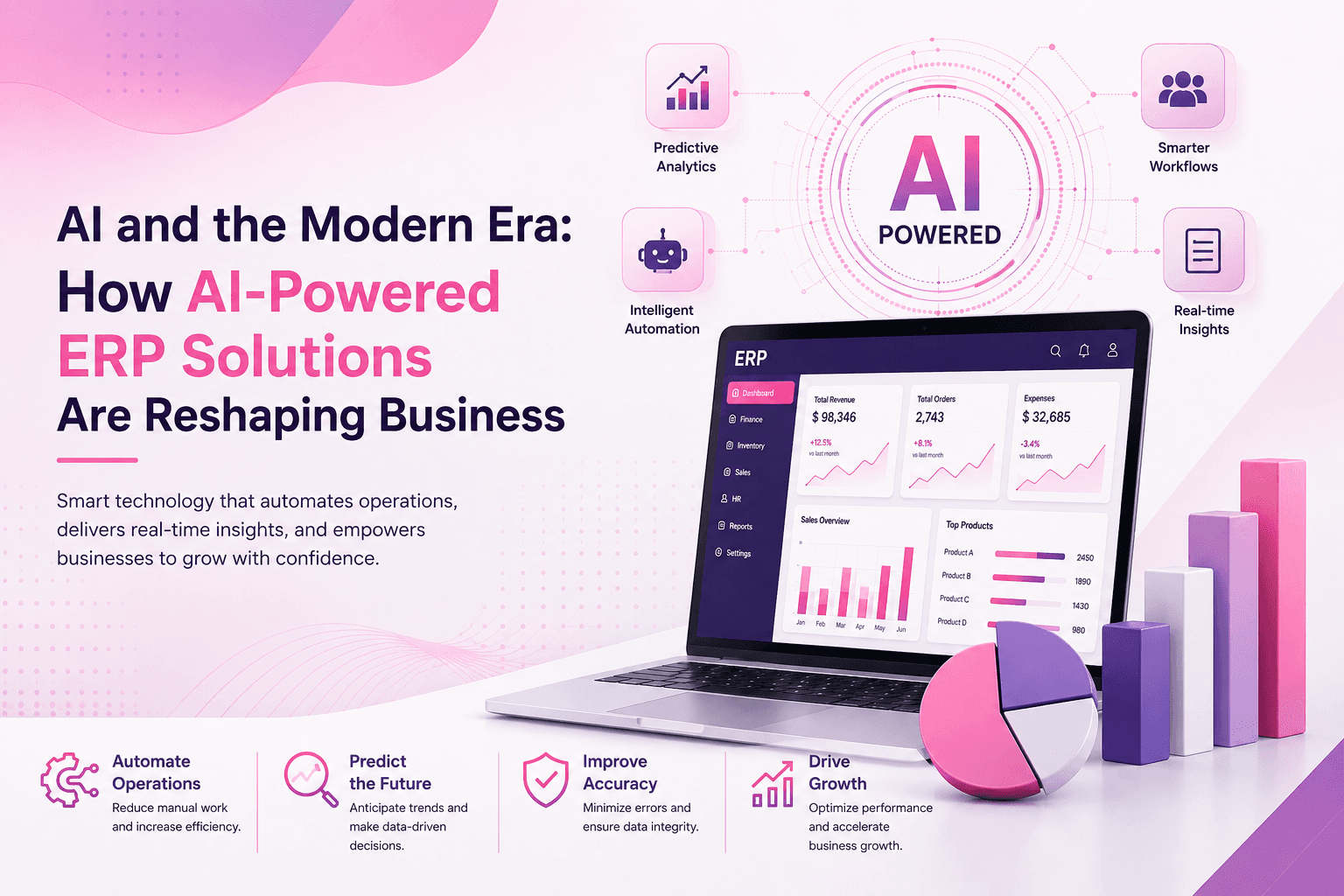
An AI-powered ERP solution is an enterprise resource planning platform that incorporates artificial intelligence and related technologies into business processes, analytics, automation, and decision support. Depending on the architecture, this can include machine learning, natural language processing, generative AI, predictive analytics, anomaly detection, intelligent document processing, recommendation engines, computer vision, and increasingly AI agents. The defining feature is not simply the presence of an AI button. The defining feature is that intelligence becomes part of the organization's operational system.
For example, an AI-powered ERP might allow a manager to ask questions using natural language rather than navigating dozens of reports. A procurement team could receive recommendations based on supplier performance and projected demand. Finance could use intelligent automation to classify documents and identify unusual transactions. HR could analyze workforce trends and highlight potential staffing gaps. Sales teams could receive customer insights based on purchasing behavior. The ERP essentially becomes a business assistant that understands the organization's operational context. This does not mean every recommendation should be accepted automatically. In high-impact areas, the strongest model is often AI recommendation + human validation + controlled execution.
How AI Is Changing the Core of ERP
AI is affecting nearly every major ERP function because nearly every ERP function generates data. Finance produces transactions and payment records. Sales generates customer interactions and orders. Inventory creates movement data. Procurement creates supplier and purchasing records. HR produces workforce information. Manufacturing generates production data. When these streams are integrated, AI can search for relationships that may be difficult for people to identify manually.
Intelligent Automation
Automation has always been one of ERP's major strengths, but AI makes automation more adaptive. A traditional automation rule might say that an invoice above a certain amount requires approval. An intelligent workflow could potentially evaluate additional factors, such as vendor history, previous invoice patterns, duplicate indicators, purchasing context, and unusual changes before routing the transaction. Similarly, customer service workflows could classify incoming requests, identify urgency, retrieve relevant records, and direct the case to the appropriate employee.
This is where the next generation of enterprise automation becomes interesting. AI agents can increasingly operate as software workers capable of performing sequences of tasks rather than answering one question at a time. Microsoft reported in its 2025 Work Trend Index that 46% of leaders globally said their organizations were already using agents to fully automate business processes, while APAC reported an even higher figure of 53%. These figures should not be interpreted as proof that every enterprise process is ready for autonomous operation. They demonstrate that businesses are actively experimenting with a model in which AI participates directly in workflows rather than functioning solely as a passive assistant.
AI and Financial Management
Finance is one of the areas where AI-powered ERP can have a particularly meaningful impact because financial operations involve huge volumes of structured transactions and repetitive processes. AI can assist with invoice processing, expense classification, reconciliation, anomaly detection, forecasting, reporting, and financial analysis. Instead of waiting until the end of a reporting period to discover that costs have exceeded expectations, intelligent systems can continuously monitor financial patterns and highlight emerging deviations.
Consider cash-flow management. A traditional report might show that a company currently has a healthy balance. That number alone does not explain what could happen three weeks from now. AI can potentially consider receivables, payment behavior, outstanding obligations, recurring expenses, seasonal trends, and historical patterns to help finance teams model possible scenarios. The result is not necessarily a perfect prediction; no responsible financial system should promise that. Instead, the value lies in giving decision-makers earlier visibility into risk. In a volatile business environment, knowing about a potential problem earlier can be far more valuable than receiving a perfectly accurate explanation after the problem has already occurred.
AI-Powered Inventory and Supply Chain Management
Inventory is another area where AI and ERP naturally fit together. Businesses constantly balance two competing risks: having too much stock and having too little. Overstock ties up capital, increases storage costs, and can create waste. Understock can lead to missed sales, production interruptions, dissatisfied customers, and emergency procurement. Traditional inventory management often relies heavily on historical averages and manually defined reorder levels. AI can introduce a more dynamic approach by analyzing multiple variables simultaneously.
Predictive Demand Forecasting
AI-based demand forecasting can examine historical sales, seasonality, product behavior, promotions, lead times, and other relevant signals to estimate future demand. A system may identify that a particular product behaves differently during certain months or that demand patterns change after price adjustments. It can also identify anomalies that human teams may overlook when working with large datasets. Rootstock's 2025 survey of more than 369 manufacturers found that 82% planned to increase AI budgets over the following 12–18 months, illustrating how strongly manufacturers are connecting AI investment with operational priorities such as efficiency and supply-chain resilience.
The real advantage comes when forecasting connects directly to ERP workflows. A forecast sitting inside a separate analytics platform is useful, but an integrated forecast can potentially influence procurement, inventory planning, production schedules, and financial projections. That creates a connected decision loop: predict demand, evaluate inventory, assess supplier capacity, recommend procurement, and monitor the result. The ERP becomes less like a filing cabinet and more like an operational control center.
AI in Human Resource Management
Human resources is also changing as AI becomes integrated with enterprise systems. An AI-enabled HR module can help organizations analyze workforce patterns, identify staffing requirements, automate repetitive administrative work, support employee queries, and generate workforce insights. Instead of HR teams spending large portions of their time answering routine questions about policies, leave balances, documents, or benefits, AI assistants can handle appropriate low-risk interactions while escalating sensitive cases to people.
There is, however, an important boundary here. Employee data is sensitive, and AI should not be given unrestricted authority over decisions that affect people's employment, compensation, or opportunities. Bias, privacy, transparency, and explainability matter enormously. A responsible AI ERP should therefore use strict access controls, audit trails, appropriate data minimization, and human review for consequential decisions. The goal is not to turn HR into an automated machine. It is to remove administrative friction so HR professionals can spend more time on leadership, culture, development, and employee experience.
AI Is Changing Customer and Sales Management
Sales teams have historically relied on CRM systems to record customer interactions, deals, follow-ups, and purchasing histories. AI can transform this information into more actionable intelligence. An intelligent ERP or connected CRM environment can analyze customer behavior, identify sales opportunities, summarize interactions, recommend follow-up actions, and potentially identify customers whose engagement patterns have changed.
The important difference is that AI can help salespeople prioritize rather than simply display information. A salesperson may have 500 customers in a database, but not all 500 deserve the same attention today. AI can potentially identify which accounts show buying signals, which customers have declining activity, and which opportunities may require immediate attention. This creates a shift from data entry toward decision support. Instead of asking employees to search through records to figure out what matters, the system can bring important signals to them.
The Rise of Predictive Business Intelligence
Business intelligence traditionally revolves around dashboards, reports, charts, and key performance indicators. These remain useful, but AI is changing how people interact with business intelligence. Natural-language interfaces can allow users to ask questions conversationally, while AI can summarize trends and explain changes in business metrics.
Imagine a CEO opening an ERP dashboard and asking, “Why did profitability fall this month?” Instead of manually opening five different reports, the system could potentially examine revenue, discounts, procurement costs, payroll, inventory adjustments, and other relevant data before presenting a structured explanation. The user can then ask a follow-up question such as, “Which product category contributed most to the decline?” This conversational model turns business intelligence from something employees have to navigate into something they can interrogate.
That does not eliminate the need for analysts. Quite the opposite. Analysts become more valuable because they can validate AI-generated insights, investigate deeper causes, design better metrics, and translate intelligence into strategic action. AI can accelerate analysis, but business judgment remains essential.
AI Agents and the Next Generation of ERP
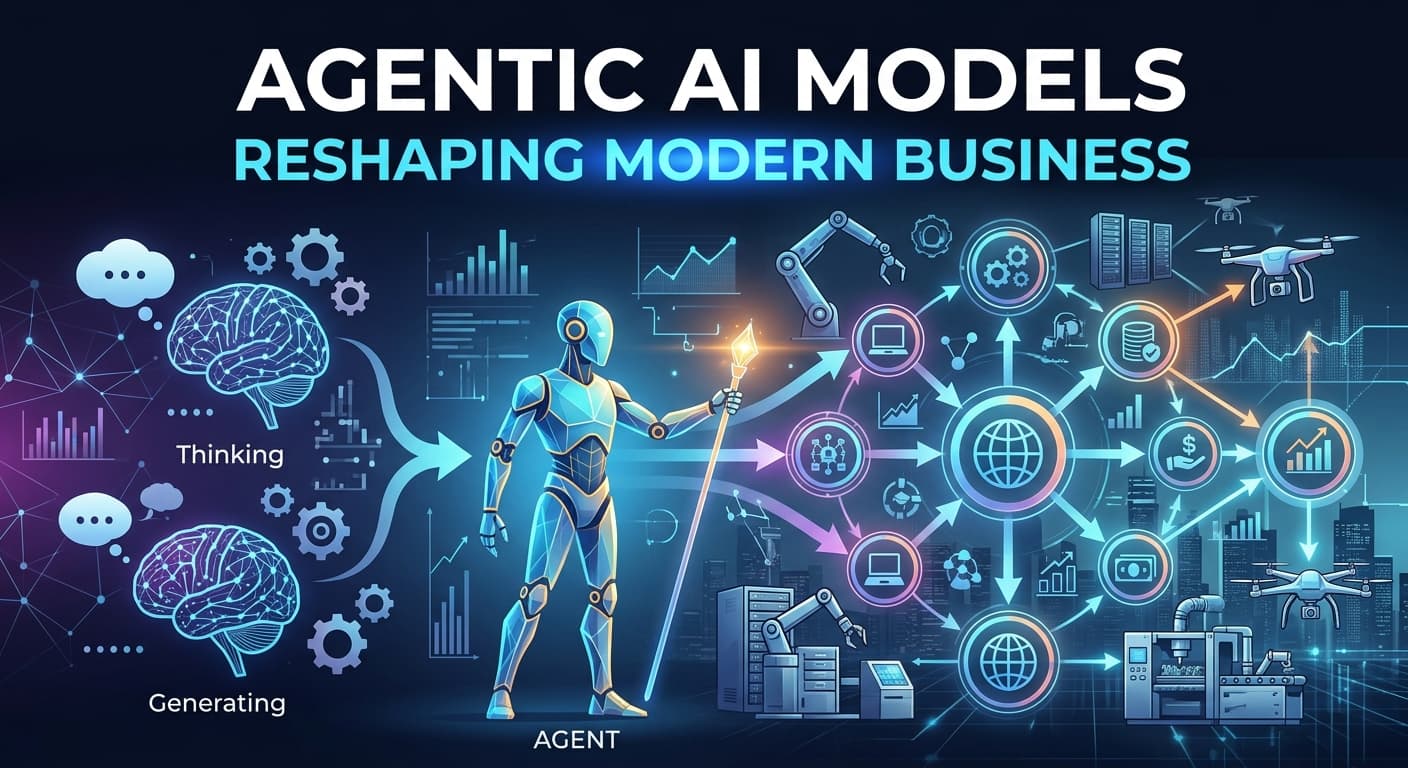
The next major step may be the integration of AI agents into ERP environments. A chatbot waits for a question. An AI agent can potentially monitor a process, reason through defined conditions, use approved tools, and execute a sequence of actions. That distinction changes the nature of enterprise software.
Imagine an ERP agent monitoring procurement. It notices that demand for a product is increasing, inventory is falling faster than expected, and a preferred supplier has an unusually long lead time. Instead of merely displaying a warning, an authorized agent could prepare a purchase recommendation, compare approved suppliers, calculate expected costs, and send the proposal to a procurement manager for approval. The human still controls the consequential decision, but the administrative work surrounding that decision is dramatically reduced.
This is also where caution becomes critical. Agentic AI introduces risks that traditional automation does not. An incorrect automated action can propagate quickly across multiple systems. That is why permissions, approval thresholds, audit logs, sandboxing, monitoring, and clear escalation paths should become core parts of AI ERP architecture. The future is not simply “more autonomous AI.” It is controlled autonomy.
Why Data Quality Matters More Than Ever
AI is often described as the intelligence layer of a modern organization, but intelligence is only as reliable as the information it can access. If customer records contain duplicates, inventory data is outdated, supplier information is inconsistent, or financial data is fragmented across systems, AI may produce confident but unreliable recommendations. This is one of the biggest misconceptions surrounding enterprise AI: organizations sometimes focus on selecting the most impressive AI model before fixing the data foundation.
A successful AI ERP strategy therefore begins with data governance. Businesses need clear ownership of data, standardized definitions, integration between systems, appropriate security controls, and processes for correcting inaccurate information. AI readiness is not merely an AI problem; it is an enterprise architecture problem. Recent enterprise AI research has repeatedly highlighted fragmented and siloed data as a major obstacle to scaling AI beyond controlled pilots. The organizations that benefit most from AI will not necessarily be those with the biggest models. They may be the organizations with the cleanest, most accessible, best-governed operational data.
Security, Governance, and Responsible AI
The more deeply AI becomes connected to ERP systems, the more seriously businesses must treat security. ERP environments can contain financial records, employee information, customer details, supplier contracts, operational data, and commercially sensitive information. Giving an AI system access to that environment without proper governance would be irresponsible.
A mature AI ERP architecture should therefore consider role-based access, data encryption, identity management, auditability, model monitoring, human approvals, data retention, and regulatory requirements. Organizations should also distinguish between information an AI can read and actions an AI can execute. A finance assistant might be allowed to analyze invoices but not independently transfer funds. A procurement agent might prepare purchase orders but require approval before submission. These boundaries turn AI from an uncontrolled automation risk into a governed business capability.
Responsible AI also requires transparency. Users should be able to understand where important recommendations came from and, where practical, trace them back to underlying business records. Trust becomes especially important when AI moves from answering questions to influencing operational decisions. A system that says “this is the answer” is less useful than one that can show why it reached the answer, what data it considered, and what assumptions influenced the recommendation.
AI ERP Across Different Industries
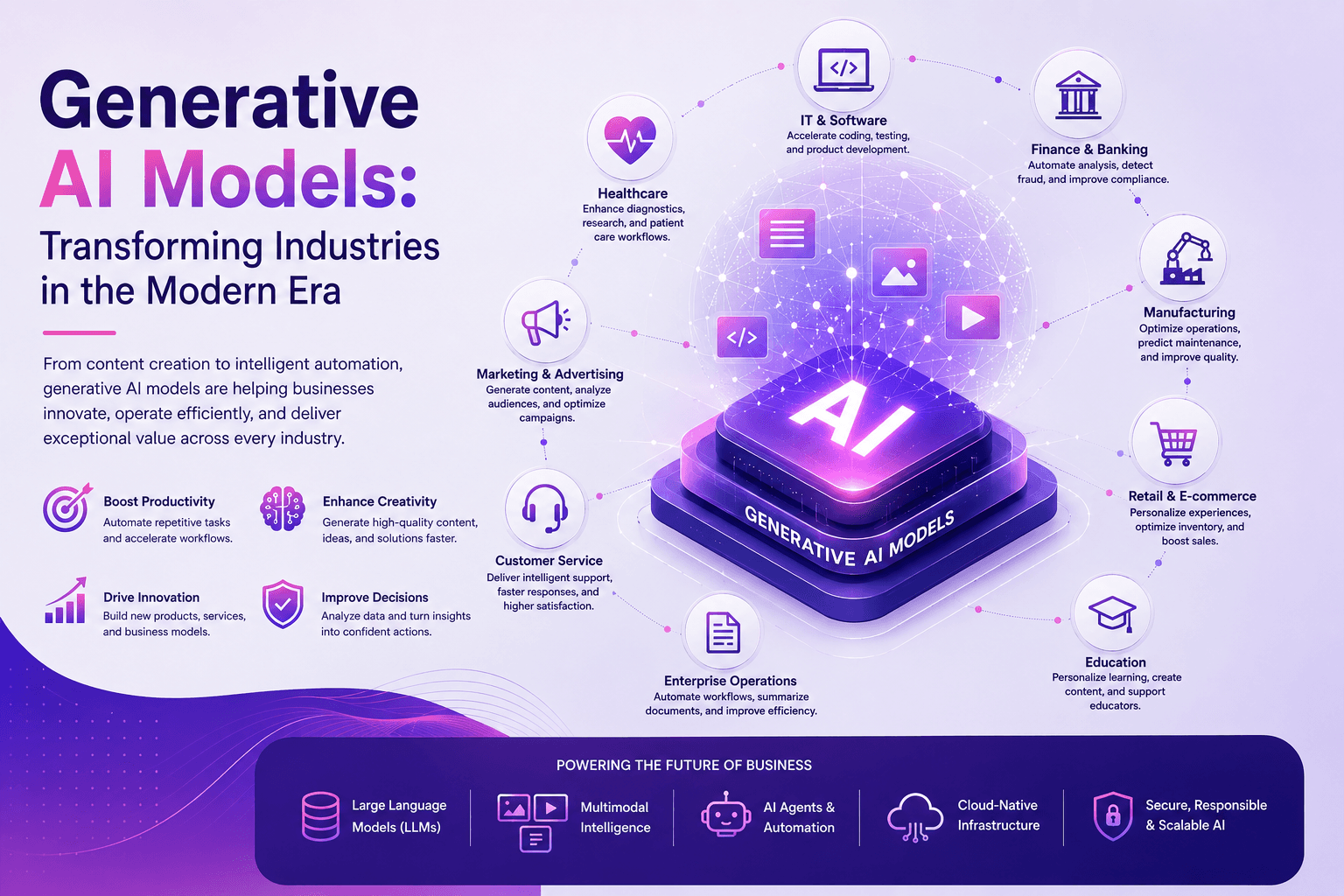
The impact of AI-powered ERP is not limited to technology companies. Manufacturing organizations can use AI to improve demand forecasting, production planning, predictive maintenance, quality monitoring, and procurement. Retail businesses can apply intelligent forecasting to inventory, pricing, customer behavior, and supply chains. Healthcare organizations can use enterprise intelligence to improve administrative workflows, resource planning, financial operations, and patient-service coordination while maintaining strict privacy controls.
Hospitality businesses can use AI-enabled ERP platforms to understand occupancy patterns, staffing needs, purchasing requirements, inventory movement, and financial performance. Education organizations can use intelligent enterprise systems for resource management, finance, admissions, HR, and operational planning. Agriculture businesses can potentially connect ERP data with forecasting and operational signals to improve purchasing, inventory, planning, and resource allocation.
The common thread is simple: every industry generates operational data, and every industry has decisions that can be improved by understanding that data earlier. The exact AI use case will vary, but the underlying principle remains consistent.
The Human Side of AI Transformation
The biggest mistake businesses can make is treating AI transformation as a software installation project. Buying an AI-enabled ERP does not automatically create an intelligent organization. Employees need training, processes need redesign, leadership needs to define measurable objectives, and teams need to understand how responsibilities change when AI enters a workflow.
Microsoft's 2025 Work Trend Index described the emergence of “Frontier Firms” built around human-agent collaboration, emphasizing that organizations are beginning to think about AI as a workforce-capacity multiplier rather than simply another software feature. That idea is important because successful AI adoption will require people to learn how to supervise systems, validate outputs, interpret recommendations, and work effectively with digital agents.
The future workplace is therefore unlikely to be simply “humans versus AI.” It is more likely to be humans plus AI, with each handling the work it is best suited to perform. Humans bring judgment, empathy, accountability, creativity, context, and ethical reasoning. AI brings speed, scale, pattern recognition, continuous analysis, and the ability to process enormous amounts of information. The competitive advantage will come from combining those strengths rather than pretending one can completely replace the other.
How Businesses Should Approach AI ERP Adoption
Businesses should resist the temptation to adopt AI simply because competitors are talking about it. The better starting point is identifying business problems. Where is the organization losing time? Where are decisions being made too late? Which processes depend heavily on spreadsheets? Where are employees performing repetitive work? Which forecasts are consistently inaccurate? Which data is trapped in disconnected systems?
Once those questions are answered, organizations can prioritize AI use cases according to business value and risk. Low-risk automation can often be a good starting point because it allows teams to build confidence. More advanced predictive analytics can follow once data quality improves. Agentic workflows should generally come later, when governance, permissions, monitoring, and process design are mature enough to support controlled autonomy.
A practical AI ERP roadmap can therefore look like this:
Assess current systems and data quality.
Identify high-value business problems.
Prioritize measurable AI use cases.
Clean and integrate relevant data.
Start with controlled automation and decision support.
Measure outcomes such as time saved, accuracy, cost, revenue, and risk reduction.
Expand successful use cases gradually.
Introduce AI agents only where governance is strong.
The key is to measure business outcomes rather than AI activity. The number of prompts generated or AI features activated is not a meaningful definition of transformation. What matters is whether the business makes better decisions, operates faster, reduces unnecessary costs, improves customer experience, and creates sustainable value.
What the Future of AI-Powered ERP Looks Like
The future of ERP is likely to become increasingly conversational, predictive, automated, and agentic. Users will interact with business systems through natural language instead of navigating every menu manually. Instead of waiting for monthly reports, leaders will receive continuous intelligence about changing business conditions. Instead of employees manually moving information between systems, AI agents will increasingly coordinate approved workflows across applications.
ERP interfaces may become less important as intelligence becomes more embedded into everyday work. A manager might not think about “opening the ERP” at all. They might simply ask an enterprise assistant what requires attention today. The system could summarize critical exceptions, explain emerging risks, recommend actions, and provide links back to the underlying records. In other words, the ERP could evolve from a destination employees visit into an intelligence layer that operates across their working environment.
But the organizations that succeed will not be those that automate everything blindly. They will be those that understand where autonomy creates value and where human control remains essential. AI will become more capable, but governance will need to become equally sophisticated.
The Competitive Advantage of Intelligent Businesses
There was a time when simply having an ERP system could provide a competitive advantage because it gave a business better visibility and process control. Today, ERP itself is increasingly becoming a baseline capability. The competitive difference is shifting toward how intelligently a company uses the information inside its systems.
Two companies may have similar revenue, similar employees, and similar ERP software. One may still rely heavily on manual reports and reactive decision-making. The other may use AI to forecast demand, identify financial anomalies, prioritize customers, automate routine workflows, and continuously monitor operational performance. The difference between them is not necessarily the amount of data they possess. It is the speed at which they can convert that data into useful decisions.
This is why AI-powered ERP is not simply an ERP upgrade. It is part of a broader transformation in how businesses operate. The organization that learns faster, responds faster, and identifies opportunities earlier has a structural advantage. As AI capabilities continue to improve, that advantage may become increasingly significant.
Conclusion: ERP Is Becoming the Intelligence Layer of Business
Artificial intelligence is changing the modern world because it is moving beyond isolated tools and becoming embedded into the systems through which organizations actually operate. ERP is one of the most important areas of this transformation because it sits at the intersection of finance, people, customers, inventory, procurement, operations, and strategy. When AI enters that environment, ERP can evolve from a system that primarily records business activity into a platform that helps businesses understand what is happening, anticipate what could happen, and determine what actions deserve attention.
The journey will not be effortless. Data quality, cybersecurity, governance, employee adoption, integration complexity, and trust will all determine how much value an organization receives from AI. Businesses that simply add an AI label to old software may achieve little. Businesses that redesign processes around reliable data, responsible automation, predictive intelligence, and human-AI collaboration have a much stronger opportunity to create lasting value.
The modern era is therefore not about asking whether businesses will use AI. That question is rapidly becoming outdated. The more important question is how intelligently businesses will integrate AI into the systems that run them. ERP is becoming one of the central battlegrounds of that transformation. And as AI continues to evolve from assistant to analyst, from analyst to agent, and from agent to an increasingly embedded layer of enterprise intelligence, the businesses prepared to adapt will have an opportunity to operate in ways that were difficult to imagine only a few years ago.
FAQs
1. What is an AI-powered ERP system?
An AI-powered ERP system uses artificial intelligence to automate processes, analyze business data, predict outcomes, and support smarter decisions.
2. How does AI improve ERP systems?
AI improves ERP systems through intelligent automation, predictive analytics, real-time insights, anomaly detection, and personalized recommendations.
3. Can AI replace ERP employees?
AI is primarily designed to automate repetitive tasks and support employees rather than completely replace human decision-making.
4. What are the benefits of AI-powered ERP solutions?
Key benefits include improved efficiency, faster decisions, reduced operational costs, better forecasting, and greater business visibility.
5. What is the future of AI-powered ERP?
The future of ERP is moving toward intelligent, predictive, conversational, and agent-driven systems that can proactively support business operations.




 AITech