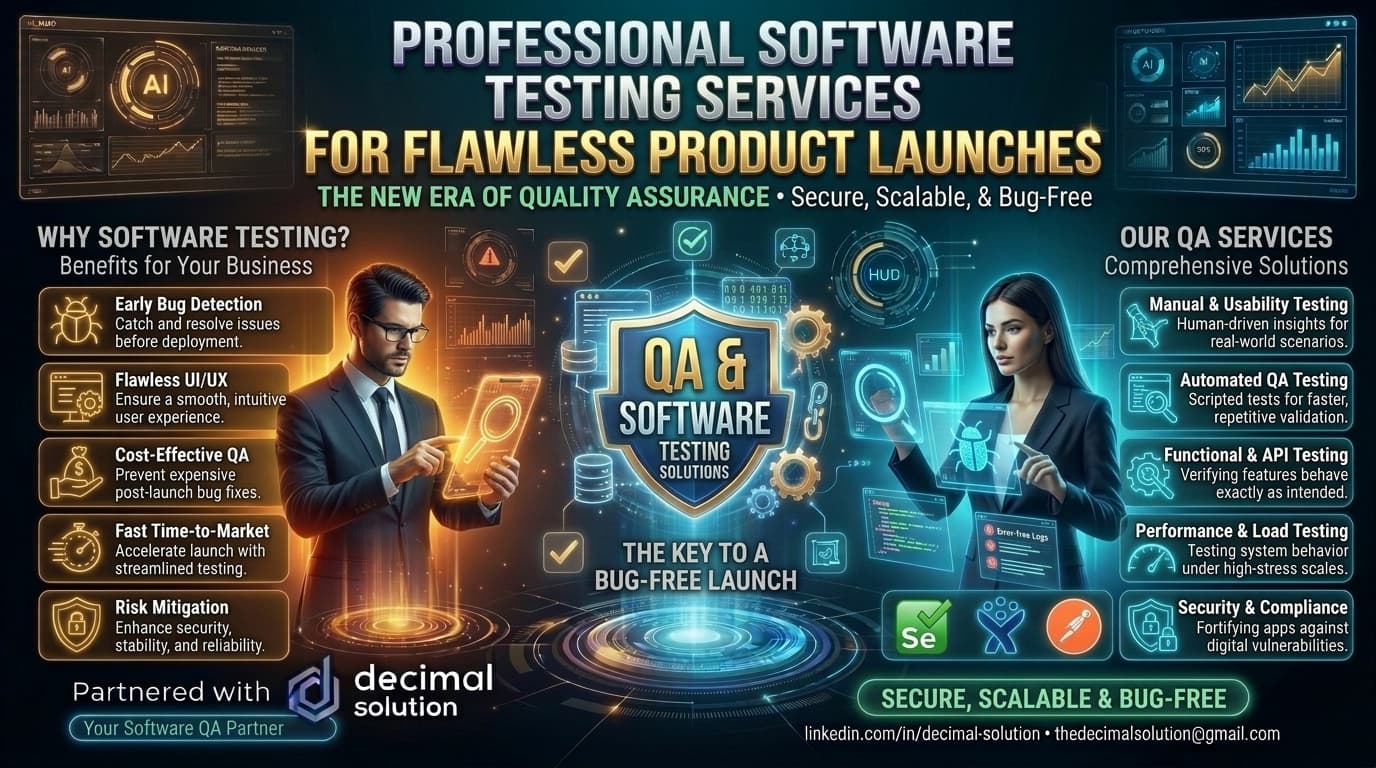
Professional Software Testing Services for Flawless Product Launches
Nowadays in the digital race, first impressions matter. And nothing kills user trust faster than a buggy app or software crash at launch. That’s why Software Testing Services aren’t just a step in your workflow—they’re the foundation of a flawless product rollout.
Let’s face it: launching without rigorous quality assurance testing is like flying a plane without a pre-check. You wouldn’t risk it—and neither should your brand.
Why Software Testing Services Matter More Than Ever
Users expect perfection. With endless alternatives available, a single glitch can send them bouncing to a competitor. A professional QA testing service ensures that your app or software isn't just functional but polished, stable, and secure—exactly what modern users demand.
What Exactly Is Quality Assurance Testing?
Quality Assurance (QA) Testing is a systematic process that evaluates software against set requirements. It helps verify that a product performs as intended, free of bugs, usability flaws, or functional gaps.
Think of it as your software's personal bodyguard—catching issues before they reach your users.
Types of Software Testing You Need to Know
Here’s a quick breakdown of the main types of software testing every business should understand:
Manual Testing
Performed by human testers, this is ideal for UI/UX feedback, exploratory testing, and ad-hoc cases. It's flexible but can be time-consuming.
Automated Testing
Best for repetitive tasks and regression testing. Automation ensures faster releases and better test coverage but requires upfront setup investment.
Functional Testing
Ensures all features behave according to the business requirements—crucial for core functionality.
Non-Functional Testing
This includes performance, security, usability, and compatibility testing—ensuring the app behaves under stress and scale.
The High Cost of Skipping Software Testing
Here’s the scary part—software failures cost businesses over $1.7 trillion annually. Bugs found post-launch are up to 30x more expensive to fix than those found during development.
Avoiding software testing might save you time today but cost you dearly tomorrow.
How Software Testing Ensures a Bug-Free App Launch
A professional QA service puts your product through rigorous checks across multiple devices, operating systems, and user scenarios. It simulates real-world usage, helping ensure users never see the rough edges.
Key benefits:
Signs You Need Professional QA Testing Services
Not sure if it’s time to hire the pros? Watch for these red flags:
In-House QA Team vs. Outsourced Software Testing Services
Pros and Cons of In-House Testing
Pros:
Full control
Team familiarity
Immediate access
Cons:
Higher operational costs
Resource bottlenecks
Slower scalability
Advantages of Outsourcing Software QA
Benefits include:
Key Features of a Great Software Testing Partner - Only Decimal Solution
Looking for a QA partner? Here’s what to prioritize:
Proven experience in your industry
Certifications like ISTQB
Full-stack testing capabilities
Transparent reporting
Agile testing methodologies
24/7 support
Must-Have Tools for Modern Software Testing
Every top-tier QA team uses a toolkit that includes:
Selenium – For automation
JIRA – For bug tracking
Appium – Mobile testing
TestRail – Test case management
Postman – API testing
BrowserStack – Cross-platform testing
The right tools ensure faster and more accurate testing results.
How to Choose the Right QA Testing Service Provider
Choosing the right QA partner can be tricky. Ask these questions:
Do they understand your domain?
Can they handle scalability?
What’s their testing methodology?
Are they communicative and agile?
What’s the feedback from previous clients?
Take your time here—it’s a long-term investment.
Common Myths About Software Testing Debunked
Myth #1: “Developers can test their own code.”
Reality: They can—but won’t catch everything due to familiarity bias.
Myth #2: “Testing delays product launch.”
Reality: It actually saves time by preventing post-launch chaos.
Myth #3: “Only big companies need QA.”
Reality: Startups benefit even more from early issue detection.
Future of QA: Trends Shaping Software Testing in 2025
Get ready for:
AI-powered testing for predictive bug detection
Shift-left testing for earlier test integration
TestOps combining DevOps and Testing
Codeless automation tools for non-tech teams
Greater focus on security testing amid growing threats
Real-Life Case Studies of Bug-Free Product Launches
A few examples:
Slack: Used pre-launch testing to refine UI/UX across platforms.
Spotify: Continuous QA allowed them to launch seamlessly across multiple countries.
Airbnb: Invested in automated testing frameworks early on—resulting in faster rollouts.
These companies know that smart testing is smart business.
Final Thoughts: Launch Smarter, Not Harder
In short, software testing services are the unsung heroes behind every successful digital product. They save you time, protect your reputation, and ensure your app delights users from day one.
Don’t gamble with your launch. Invest in quality assurance and go to market with confidence.
FAQs
1. What is the difference between QA and QC in software testing?
QA (Quality Assurance) is process-focused; QC (Quality Control) is product-focused. QA prevents defects, while QC identifies them.
2. How long does software testing usually take?
It depends on project size, but typical timelines range from a few weeks to several months for large applications.
3. Is manual testing still relevant in 2025?
Absolutely. Manual testing is crucial for usability, exploratory tests, and real-world scenarios that automation may miss.
4. Can software testing be automated completely?
Not entirely. While automation handles repetitive tests, manual input is vital for creative, UI-based, and dynamic scenarios.
5. How much do software testing services cost?
Costs vary by complexity, platform, and provider. Basic testing may start from a few hundred dollars, while enterprise-level QA can cost thousands.
6. What industries benefit most from software QA services?
All of them—especially fintech, healthtech, e-commerce, and SaaS platforms, where uptime and user trust are critical.
Get in Touch With Us!
Let us assist you in finding practical opportunities among challenges and realizing your dreams.
linkedin.com/in/decimal-solution — LinkedIn
thedecimalsolution@gmail.com — Email




 EHR History & Evolution