Blog Data
Why Users Are Switching to ChatGPT for Search
Let’s be honest, ChatGPT is no longer just a fun tool to play with. It’s become the go-to for fast, clear answers. Whether you need a quick explanation or a deep dive into a topic, ChatGPT gives you results in seconds without needing to click through endless pages.
Many users enjoy how conversational and natural it feels. Instead of traditional search engine clutter, they get a clean, direct response.
Google’s Strategic Response: Web Guide Launch
What Is Google Web Guide?
Google’s Web Guide is a new search framework designed to make online exploration more efficient. Instead of giving a list of ten blue links, it creates topic-driven search experiences supported by AI and structured information.
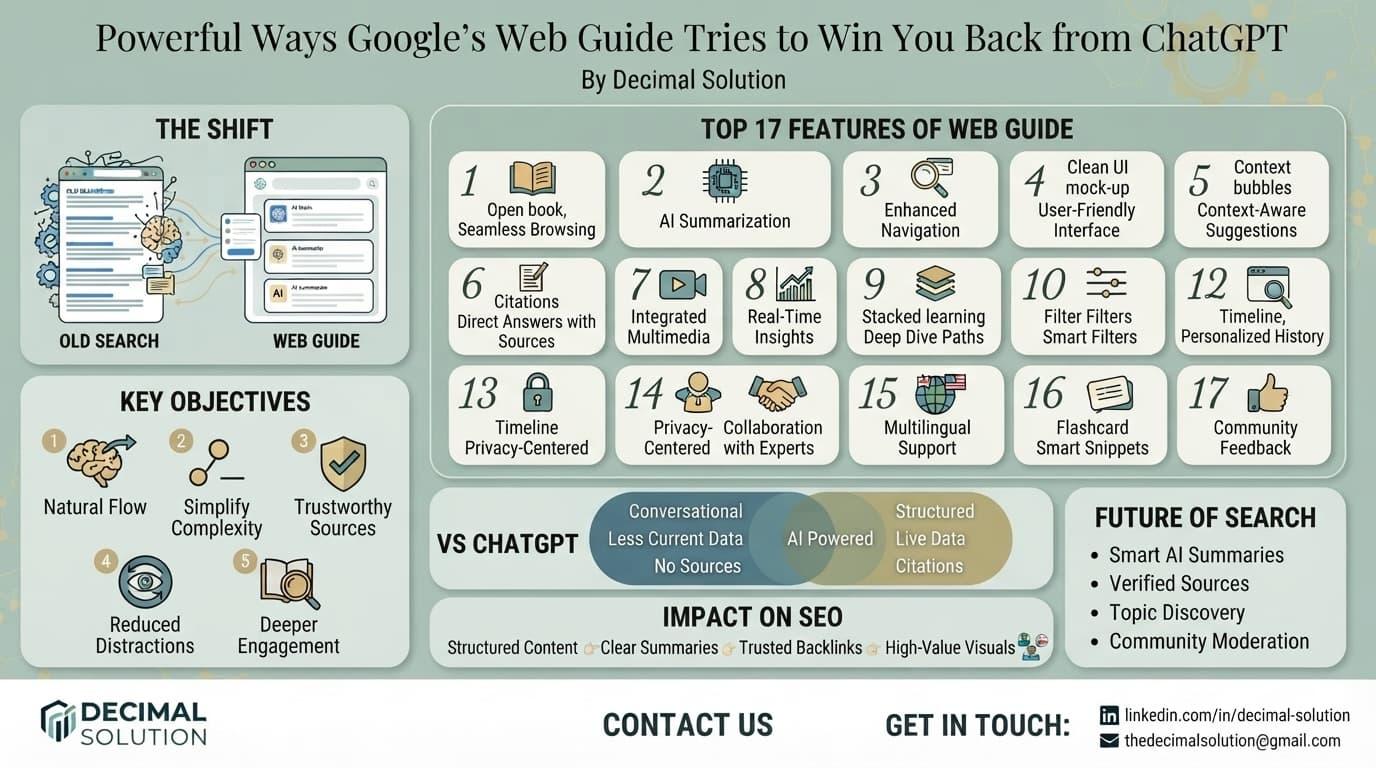
Key Objectives of Web Guide
Deliver a more natural and educational search flow
Simplify complex topics using AI summaries
Highlight trustworthy sources and insights
Keep users informed while reducing distractions
Encourage deeper engagement with quality content
Top 17 Features of Google’s Web Guide
1. Seamless and Sleek Browsing Experience
Google blends web results, summaries, and navigation into a continuous flow. You scroll through a topic rather than jump between links, making it easier to absorb information.
2. AI-Powered Topic Summarization
Each major query includes a summary at the top, generated by AI using trusted sources. You get a clear overview before deciding where to dive deeper.
3. Enhanced Search Navigation
The interface offers tabs, filters, and previews to guide you through content. Search results are now dynamic hubs instead of static lists.
4. User-Friendly Interface
A cleaner, more modern look welcomes users. Content is spaced well and interactive cards replace blocks of text.
5. Context-Aware Suggestions
As you browse or type, Google recommends related subtopics based on your current session. This helps users discover more without losing focus.
6. Direct Answers with Sources
You no longer get vague summaries. Every AI-generated answer links directly to the source, boosting trust and transparency.
7. Integrated Multimedia Results
Videos, images, infographics, and even podcasts appear alongside search results. Google wants to match every learning style.
8. Real-Time Trends and Data Insights
Users see real-time updates on what’s trending. You don’t need to visit Google Trends separately to track data anymore.
9. Deep Dive Learning Paths
Users can follow structured guides through a topic. Each section builds on the previous one, perfect for research or self-learning.
10. Smart Filters and Sorting
You can refine results using toggles such as “tutorials only” or “recent articles.” This saves time and improves relevance.
11. Voice and Multimodal Search
Ask questions by voice, upload an image, or use text input. Google combines different modes into a single query experience.
12. Personalized Search History Insights
Your previous searches influence new suggestions. Visualized timelines and topic clusters help you track and revisit older queries.
13. Privacy-Centered Experience
Google is adding better privacy controls. You can decide how much of your search history is used to personalize results.
14. Collaboration with Experts
Google now features summaries and learning guides curated with input from scientists, professors, and field professionals.
15. Multilingual Support and Global Focus
Content summaries are now available in multiple languages. Users from different regions receive content tailored to local context.
16. Smart Snippets for Quick Understanding
Difficult topics are broken into short, digestible sections. Think of it like a flashcard summary built into your search result.
17. Community-Based Feedback System
You can now rate AI summaries, suggest edits, and flag outdated or incorrect content. This helps improve quality over time.
How Does It Compare with ChatGPT?
ChatGPT is ideal for instant, human-like responses to casual or technical queries. However, it doesn’t always show sources or offer live data. Google’s Web Guide answers this gap by combining AI with current information, complete with citations.
If ChatGPT feels like chatting with a knowledgeable friend, Google Web Guide feels more like walking through a curated museum of ideas.
Impact on SEO and Content Creators
Content creators must adapt quickly. Google now favors well-structured, trustworthy, and multimedia-rich content. Basic keyword stuffing no longer cuts it.
Here’s what matters now:
Structured content with headings and subtopics
Clear summaries and concise conclusions
Trusted backlinks and author credibility
High-value visuals and supporting media
Adapt your SEO strategy to meet these demands or risk falling behind.
Expert Opinions on Google’s Web Guide
Tech experts are largely optimistic. Rand Fishkin, founder of SparkToro, called it “Google’s smartest pivot in recent years.” Reviewers praise the combination of AI convenience with classic Google reliability.
Educators, content strategists, and developers also appreciate the layered content approach that supports deep learning.
Future of Search: AI Plus Human Collaboration
Search is becoming less about results and more about guidance. The future will involve:
Smart AI summaries
Verified sources
Topic-driven discovery
Community moderation
Users want clarity and trust. Google is betting on this combination to win users back from ChatGPT.
Conclusion: Is Google Back in the Game?
Google is not just back. It is stepping into a new era of intelligent search. The Web Guide combines AI efficiency with the depth of real-time data, human expertise, and community input. While ChatGPT remains strong in casual and creative conversations, Google is reshaping how we explore and learn on the web.
For users who crave clarity and trust, this is a promising leap forward.
FAQs
1. Is Google Web Guide available for all users now?
It is currently available for select users in specific regions. A broader rollout is expected soon.
2. Can I switch back to classic search results?
Yes, users can toggle between traditional results and Web Guide features through settings.
3. Are AI summaries always accurate?
While they are sourced from verified websites, users can still report inaccuracies using built-in feedback tools.
4. How does this affect my website’s ranking?
Websites with high-quality, organized, and credible content are more likely to be featured in the Web Guide structure.
5. Will this replace ChatGPT?
Not entirely. ChatGPT remains valuable for conversational responses. Google Web Guide complements it by offering structured exploration.
6. Can creators optimize content for Web Guide?
Yes. Focus on E-E-A-T (Experience, Expertise, Authoritativeness, Trust), include multimedia, and structure your content for clarity.
Get in Touch With Us!
Let us assist you in finding practical opportunities among challenges and realizing your dreams.
linkedin.com/in/decimal-solution — LinkedIn
thedecimalsolution@gmail.com — Email




 Logistics & Fleet Management