Introduction to the Hybrid Chip Era
We are entering a bold new chapter in computing history. For decades, Moore’s Law helped guide microchip development. Smaller sizes, faster speeds, and lower costs were the norm. But now, even the most advanced silicon chips are running into limits. That is where the hybrid chip steps in, combining electronics, photonics, and quantum technologies into one revolutionary system.
This new chip is more than an upgrade. It is a complete rethinking of how microchips function. Developed by researchers at MIT and MITRE, this chip blends multiple forms of computing power into a single architecture. The result is a system that is faster, more efficient, and capable of processing massive amounts of data in real time.
What Makes This Chip “Hybrid”?
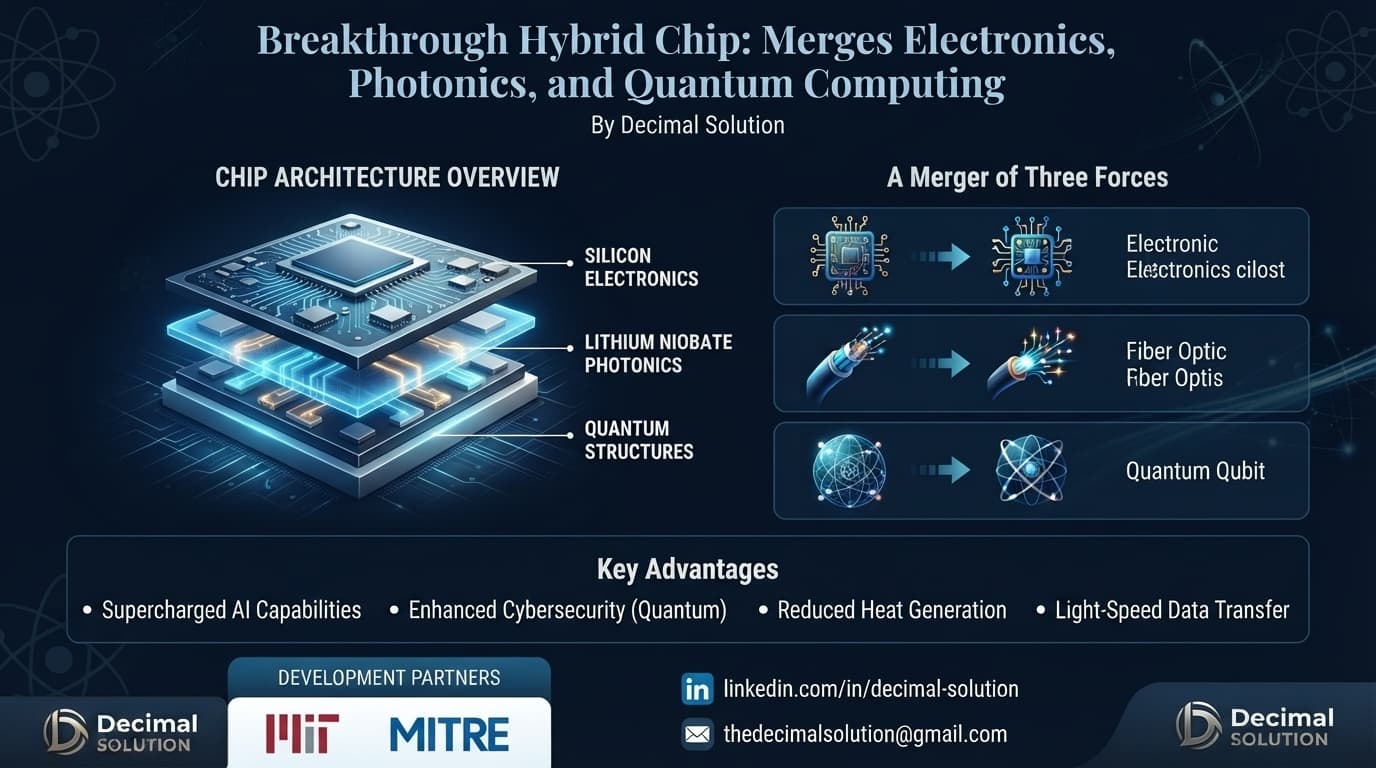
The hybrid chip brings together three unique technologies:
Electronic transistors for traditional processing
Photonic waveguides for light-based data transfer
Quantum structures for advanced parallel processing
Each element solves a problem that has long plagued conventional chips. When used together, they form a powerhouse that can compute with unmatched precision, speed, and efficiency.
A Merger of Three Forces: Electronics, Photonics, and Quantum
Think of this chip like a relay team. Electronics manage control and logic operations. Photonics carry information at light speed. Quantum systems perform complex computations that classical systems struggle with. Combined, they offer a complete transformation in how data is handled.
Why Traditional Chips Are No Longer Enough
Moore’s Law predicted consistent gains in chip performance by doubling transistor density every two years. But physical limitations such as heat generation and energy loss have slowed progress. These challenges have led to a plateau in innovation. The hybrid chip is designed to overcome these hurdles using smarter architecture and new materials.
Electronics: The Backbone of Modern Computing
For decades, electronics have powered everything from smartphones to supercomputers. Transistors made from silicon control the flow of electrical signals, processing logic at blazing speeds.
Limitations of Electrical Transistors
Produce excessive heat under load
Experience signal degradation over distance
Require large energy input for high performance
Why Photonics and Quantum Fill the Gap
By introducing light and quantum-level processing, hybrid chips reduce power usage, increase speed, and enhance accuracy. This is how they overcome the inherent weaknesses of silicon-based designs.
Photonics: The Speed of Light Advantage
Photonics replaces electrons with photons to carry information. Since photons travel at light speed and do not generate heat in the same way, they are perfect for high-speed, low-loss computing.
How Light-Based Computing Changes Everything
Increases data transfer speeds significantly
Cuts down on power consumption
Reduces interference and data corruption
Real-World Applications of Photonic Integration
Photonics can improve many systems, such as:
Financial trading platforms
High-definition video processing
Data center communications
Quantum Mechanics Meets Microchips
Quantum computing harnesses the principles of physics at the atomic scale. Instead of classical bits, quantum systems use qubits that can represent multiple states at once.
The Role of Quantum Bits (Qubits)
Qubits allow for parallel processing of complex tasks that traditional systems would take years to compute. This makes them ideal for fields like cryptography, molecular simulation, and artificial intelligence.
How Quantum Effects Improve Computation
Using quantum superposition and entanglement, the hybrid chip can solve mathematical problems more efficiently. This includes simulating biological processes or optimizing logistical operations.
Synergizing the Three: How the Chip Works
The real magic of the hybrid chip lies in its integration. It is not just a combination of three systems but a unified design where each part complements the others.
Architecture and Design Explained
Built using layers of silicon and lithium niobate
Includes embedded quantum structures
Features photonic waveguides for optical signal paths
Power Efficiency and Heat Management
Because the chip relies less on electric current and more on light, it generates far less heat. This makes it ideal for compact systems and mobile computing devices where energy use is a top concern.
Use Cases: From AI to Cybersecurity
This hybrid chip is not just a research experiment. It has the potential to improve performance across multiple industries.
Supercharged AI Capabilities
Accelerates machine learning training
Enables real-time language and image recognition
Reduces latency in edge devices
Enabling Secure Communications
By integrating quantum technologies, the chip enhances encryption and data protection. This is particularly useful in sectors like finance, defense, and healthcare.
Breakthrough Led by MIT and MITRE
Unlike many tech innovations that come from big corporations, this hybrid chip was born out of academic and nonprofit research.
What’s Different About Their Approach
Combined materials not typically used in consumer chips
Designed for open-ended research rather than commercial constraints
Allowed for greater risk-taking in experimentation
Industry and Government Implications
The new chip could drive advancements in aerospace, autonomous systems, and national security applications. It may also serve as the foundation for future public infrastructure technologies.
External Expert Opinions and Validation
According to a recent article in Nature, this development is considered a foundational step in computing. Researchers and engineers across the globe have acknowledged it as a key innovation that could shape the next 50 years of digital advancement.
Limitations and Challenges Ahead
Even though the hybrid chip is promising, it still faces hurdles before it can be widely adopted.
Scalability Concerns
Manufacturing and Cost Barriers
What's Next in Hybrid Chip Evolution
We can expect this technology to be refined over time. Future versions may become smaller, cheaper, and more widely available. Companies are already exploring commercial use cases in sectors like
The next decade could see hybrid chips becoming a central part of consumer electronics and public technology systems.
Final Thoughts: The New Computing Frontier
The hybrid chip is more than a hardware upgrade. It represents a complete shift in how we think about processing data. By bringing together electricity, light, and quantum mechanics, this innovation creates a powerful platform for solving the toughest challenges of our time.
Whether you are in tech, healthcare, defense, or finance, this chip could become the backbone of your next-generation systems. The future of computing is no longer limited by the boundaries of silicon.
Frequently Asked Questions (FAQs)
1. What is a hybrid chip in computing?
It is a chip that integrates electronics, photonics, and quantum technologies to improve performance, energy efficiency, and data processing power.
2. How does photonic computing differ from traditional methods?
Photonic computing uses light instead of electricity to transfer data. This allows for faster speeds, less heat generation, and reduced energy use.
3. What are the benefits of quantum elements in hybrid chips?
Quantum elements allow for more secure communications and faster problem-solving, especially in AI and cryptographic applications.
4. Can hybrid chips be used in everyday devices?
Not yet, but researchers are working to make them more scalable and cost-effective. Eventually, they could be used in laptops, smartphones, and edge devices.
5. Who is behind the development of the hybrid chip?
Researchers from the Massachusetts Institute of Technology (MIT) and MITRE Corporation led the project, combining their expertise in engineering, physics, and material science.
6. How soon will we see hybrid chips in the market?
Commercial availability is still a few years away. Research is ongoing to address scalability and cost issues.
Get in Touch With Us!
Let us assist you in finding practical opportunities among challenges and realizing your dreams.
linkedin.com/in/decimal-solution — LinkedIn
thedecimalsolution@gmail.com — Email




 Logistics & Fleet Management